
|
|

 |
 Click any photo below for larger photo. Then click large photo to return to the story. |


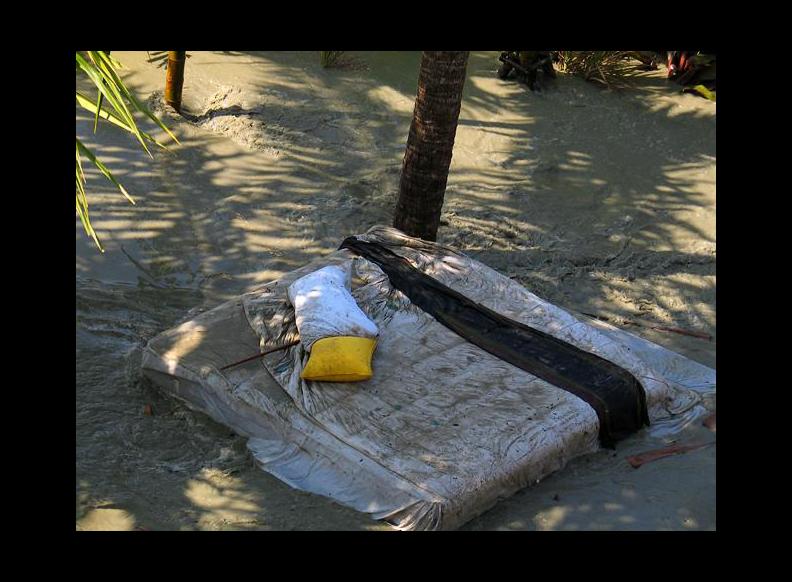
 In five years Don and I had visited relatives and attended overseas conferences, functions and funerals, but we had not been on a holiday. Four of those five years we had taken care of my mother in deteriorating health. A year after Mamma passed away we decided on a holiday. We chose paradise, an earthly one we both know as Bali. Just days before our departure we are informed that Indonesia is to be targeted by al Qaeda over Christmas and is unsafe for tourists. We change our travel arrangements. We choose our next paradise, Batu Ferringhi. But we had spent some time in April at the Muthiara in Batu Ferringhi when we travelled to Penang to scatter Mamma’s ashes in the Indian Ocean to be with her husband. So we change our destination again. We weigh the possibility of other quiet and relaxed places. Don mentions Phuket. I am a little reluctant. I had recently blogged about trouble in Southern Thailand between the Muslims and non-Muslims. We both had been to Phuket before but that was a long time ago. Finally we listen to our travel planner and Phuket it is. On a perfect winter morning, Thursday, 23rd December 2004, we set off. Hong Kong taxi drivers are a temperamental lot but not Sam. He is friendly but not chatty. He arrives at our home on time, helps us with our luggage, settles us in comfortably and drives within the speed limit, smooth and in control. Airport check-in is easy and quick. I do my normal shopping for duty-free cosmetics and magazines while Don gets his airline goodies: chocolates and books. On the plane we are taken care of by the efficient and cheerful Cathay Pacific crew. Don watches the in-flight movies and I read. Time passes quickly. The only grouch I have is that half the plane is totally empty while we are cramped in the forward compartment and queuing up for loos. I can only imagine the air crew did not want to rush about serving a scattered lot of passengers in two cabins. Soon after lunch an Indian family comes alive and proves to be a public nuisance. They are unaware that there are others on the plane. They are noisy and talk loudly. Father becomes more alive and vociferous with each tot of whisky. He spends much of his time conducting the party standing in the aisle. Their three young daughters run about annoyingly and talk with a couple they call Auntie and Uncle who are at the rear end of the cabin. The mother does her best to carry on a conversation with all six of them. We are mistaken in thinking we are going to Phuket. Only after landing do I realize that Le Meridien Khao Lak Resort and Spa is a 90-minute drive from Phuket Airport. From then on our whole trip is a series of unexplainable coincidences. Our travel planner has forgotten to arrange transport to the hotel. It’s like hospital visiting hours, where everyone has visitors except us. People come and go and people get picked up by hotel transport while we sit waiting with our luggage. Having left Hong Kong in the pleasant 12C cool of winter, we find it uncomfortable in the heat and humidity of 32C. A representative from Khao Lak is most apologetic --we have to wait; there is small hitch in the travel plan. Every few minutes he informs us that our hotel transport is on its way. This comforts us to a small extent, but after about twenty minutes on a hard wooden bench outside a noisy airport I begin to wilt. Sitting out in the noonday sun at Phuket Airport is not quite what had I envisioned as the start of our Thai holiday. Soon a white Mercedes arrives. We slide into the cool, sparkling white interior of this luxurious car. The long hot wait is forgotten. A silent, efficient chauffeur stows our bags, gets in, adjusts his control panel like a pilot readying for take-off -- and promptly switches off the soothing Thai music we are enjoying. I do not tell him to leave the radio on in case we end up with some other gaudy pop music, Thai or Western, for foreign enjoyment. We glide away. Not a word is spoken by the driver. We trust he knows where we are going. The road is smooth, with lush hills and forests that shift from right to left as we look out. And all the time we are close to the sea with miles of beaches and small fishing and tourist villages. Every time we get close to a village or a cautious bend in the road we are pleased to find serrated ridges running across the road that warn us to slow down. Don and I agree this is brilliant idea that the Hong Kong transport department ought to copy. We also pass many billboards announcing famous resorts whose entrances are small lanes leading into what seem like thick, remote jungles. One and a half hours later we arrive at our own jungle lane. 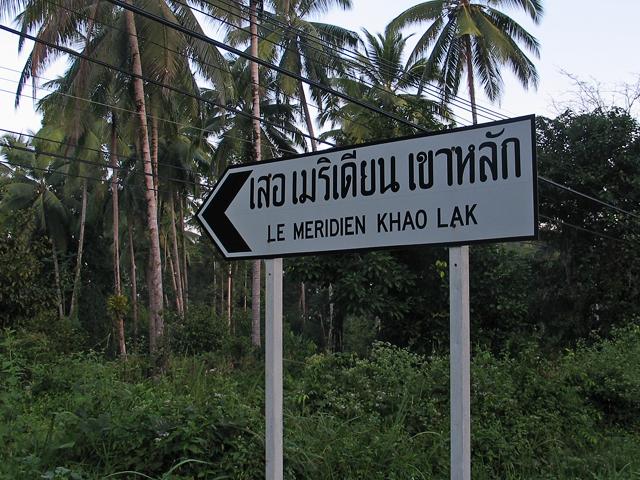 The main gate to Le Meridien Resort and Spa Khao Lak is impressive... 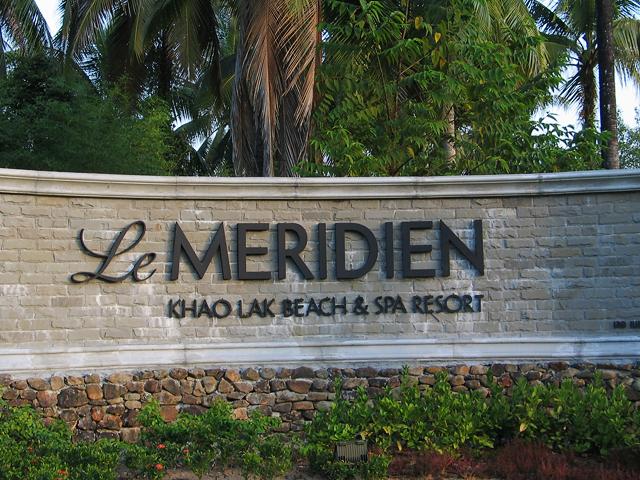 ...and is manned by a guard. We drive along an amazing roadway with well-established trees, masses of orchids, and miniature water-lily ponds and spirit houses. At hotel reception, we are welcomed with a weird cool brown drink. The staff is super courteous and super pleasant. Just as well, for we soon find out we have to pay a princely sum for the hotel limousine. We could have taken any airport limousine and not have sweated it out on a bench outside the airport. An elegant lady and a driver take us in a golf cart to our suite, which is only a two-minute walk from the reception foyer. We are on the second floor and Don is not too pleased about the walk up two flights of stairs. But all is forgiven and forgotten when he sees our suite, large and luxurious and with a fabulous view. And we have a huge glass-panelled bathroom. 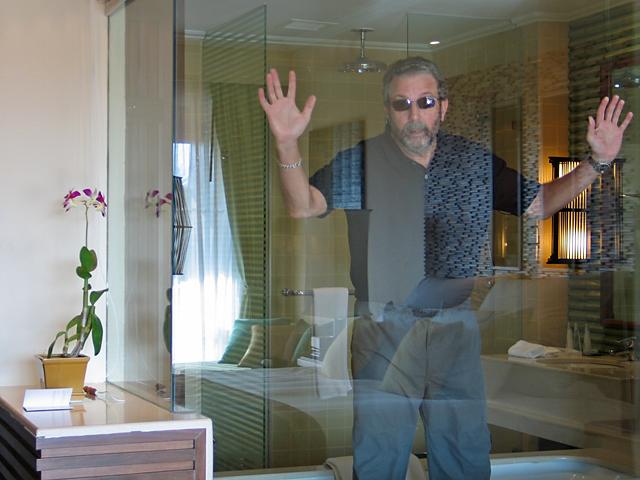 Our luggage has miraculously arrived. The first thing that Don does in any new hotel is jump on the bed to test it for comfort. He bounces around like a five-year-old and the bed passes his 180-pound test. 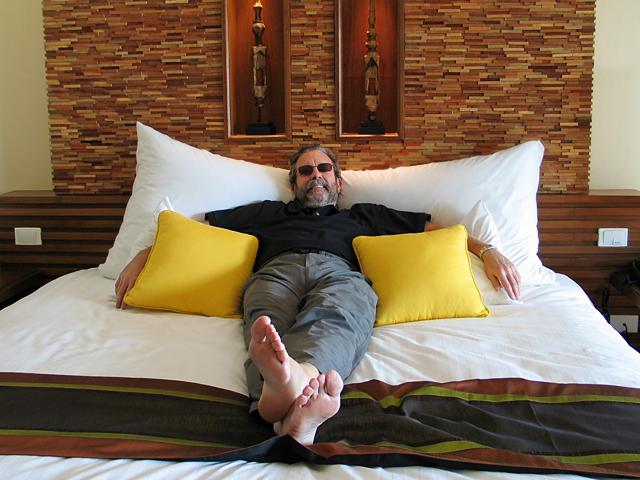 The balcony is my favourite. It passes the test, too. We have been finally transported. 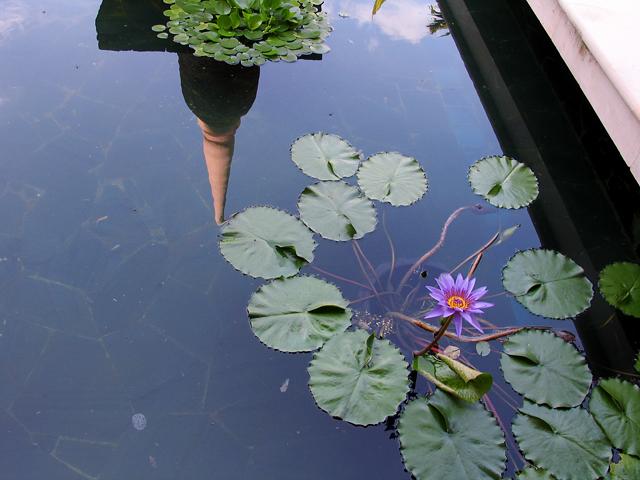 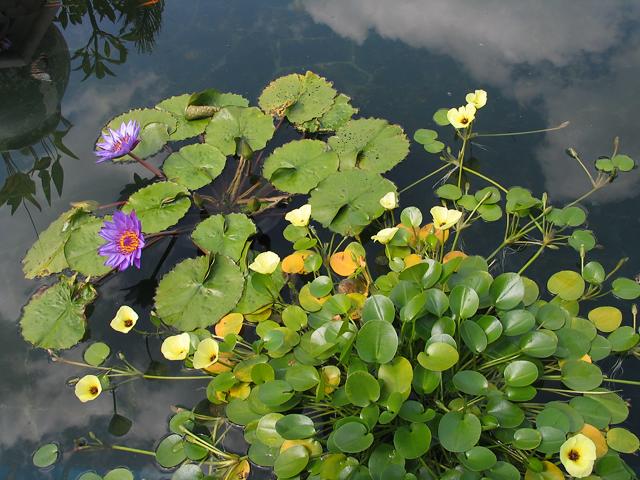 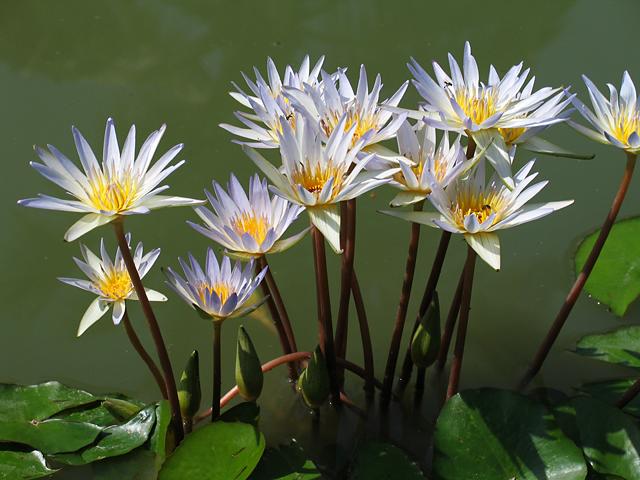 Our balcony faces one of several small pools surrounded by trees and flowering bushes and orchids... my kind of perfect everything. The weather is a bonus, cool and sunny. We want nothing more than to be together and relax in this world at peace. It is early evening. We sit on the balcony for a while before we check out the gardens of the hotel and then go for a walk along the beach. 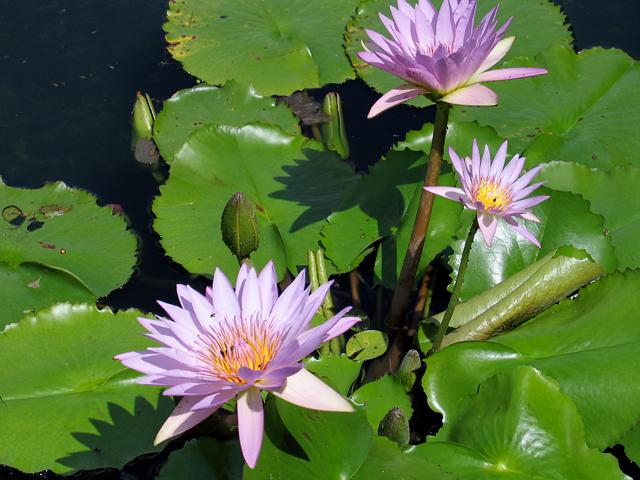 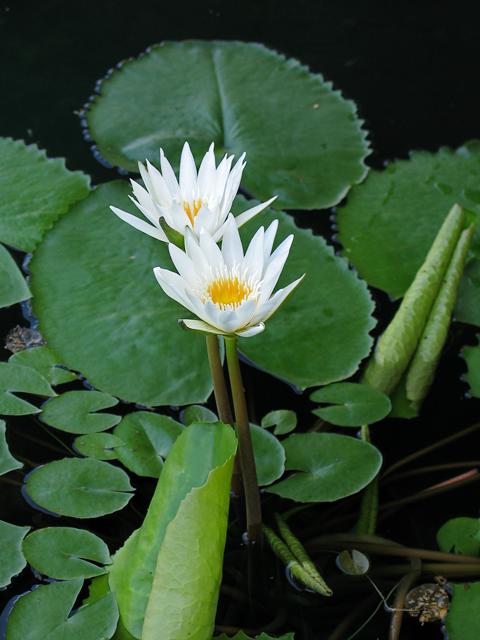 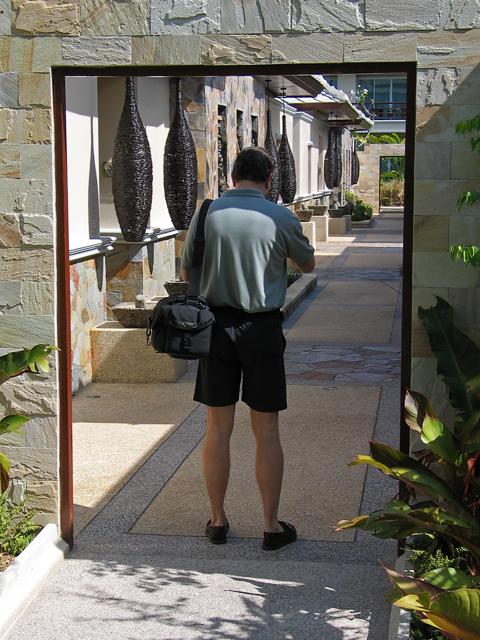 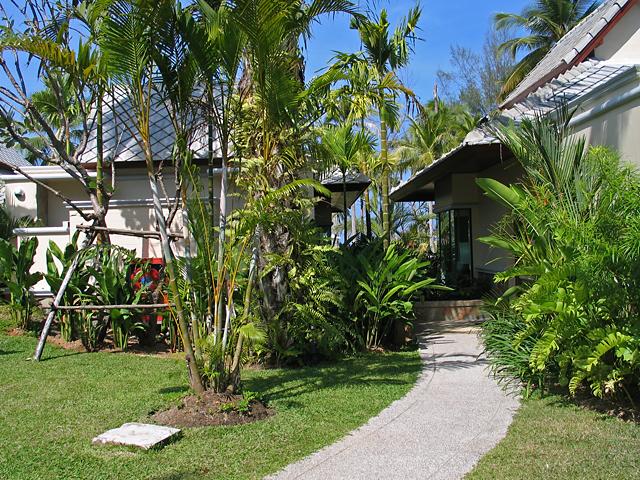 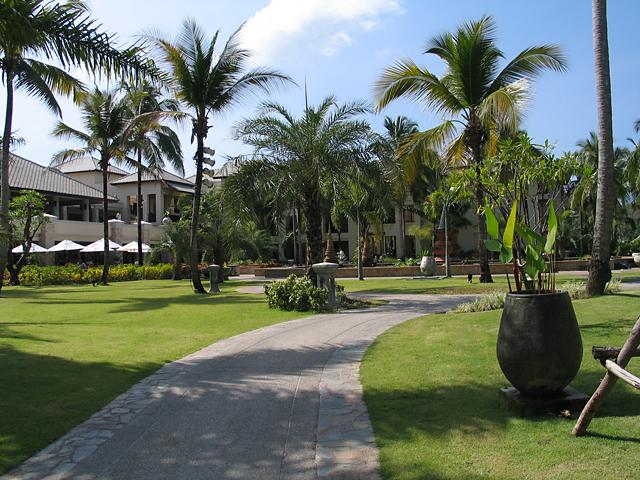 The peace is shattered by what sounds like a distant fire alarm. At first we cannot figure out where the long sharp whine is coming from. It sounds like a fire or burglar alarm, too tinny to be anything but mechanical, uncomfortable and annoying. We both make several guesses as to what it could be and after about fifteen minutes we realize it is the sound of cicadas. They start about five in the evening and continue until sunset. It is not the cicada sounds we are used to hearing in other tropical regions -- Malaysia, Vietnam, Indonesia or Hong Kong. We walk along the beach to the left of the hotel. A wide expanse of clean white sand stretches a long way. We pass where the rich and elite stay -- hotel bungalows and chalets on the waterfront with plunge pools, gardens, play areas, and mammoth hammocks outside each chalet. We admire three young men putting the finishing touches to their eight-foot-long sand mermaid. 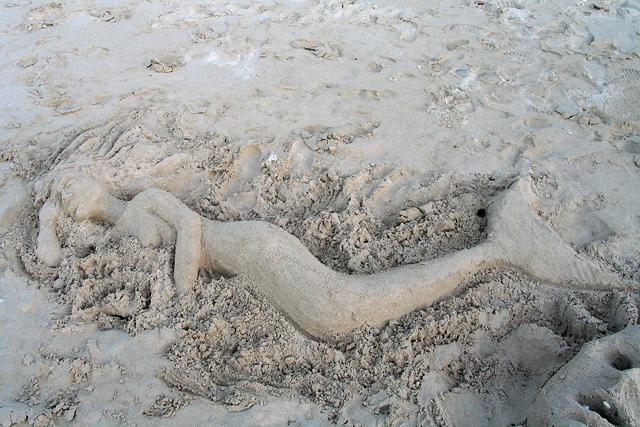 As we carry on we come to a less built-up area. 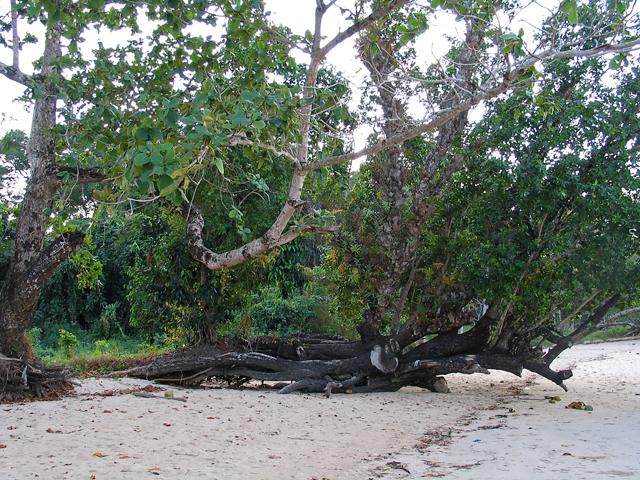 There are no homes here. We meet three docile dogs. They follow us for a while, and one adopts us... 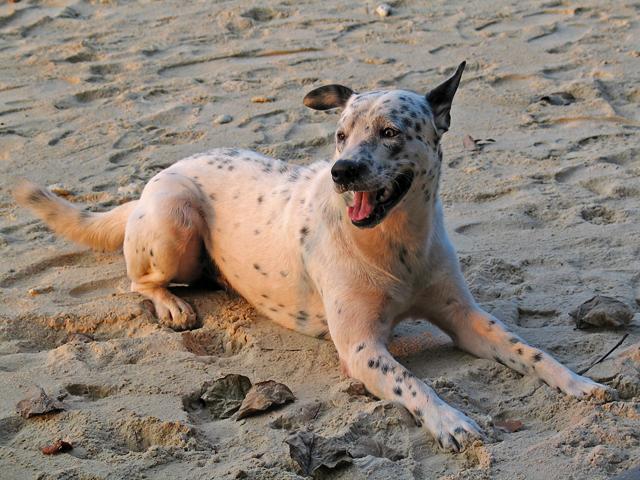 ...while the other two wander away, aimless. We get to a rocky patch. The fire-alarm cicada whine is even louder here. Don runs along the beach... 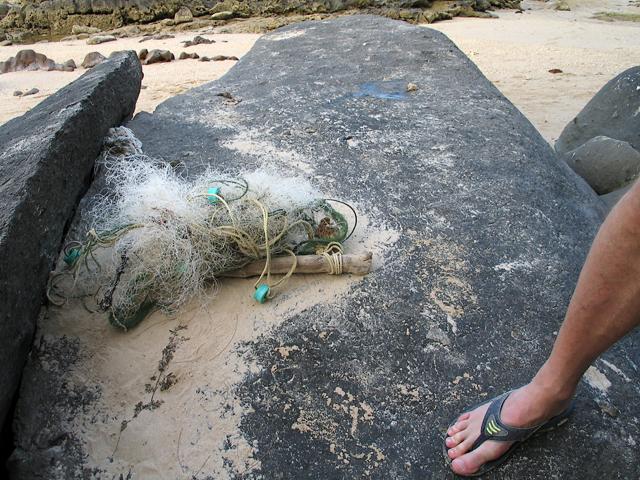 ...and then from tree to tree, an excited, pioneering biologist trying to find the cicadas without success. 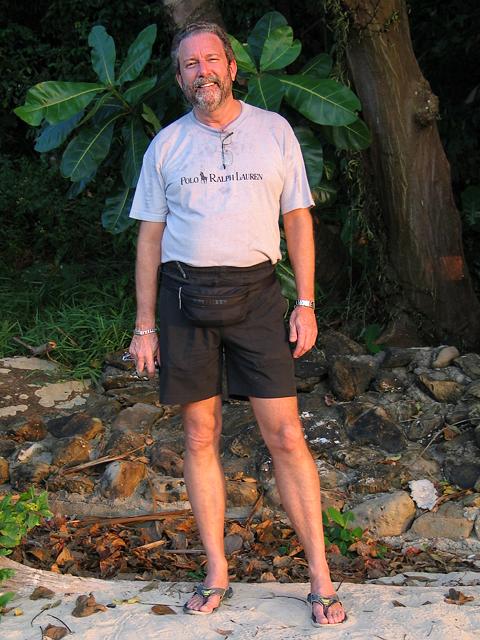 To my great pleasure someone has rigged up a swing from a large overhanging tree. The narrow wooden seat is very close to the ground and the thick frayed ropes are salty damp. The ropes keep tangling and the swing keeps going round and round. A good ten minutes of this makes me quite giddy. 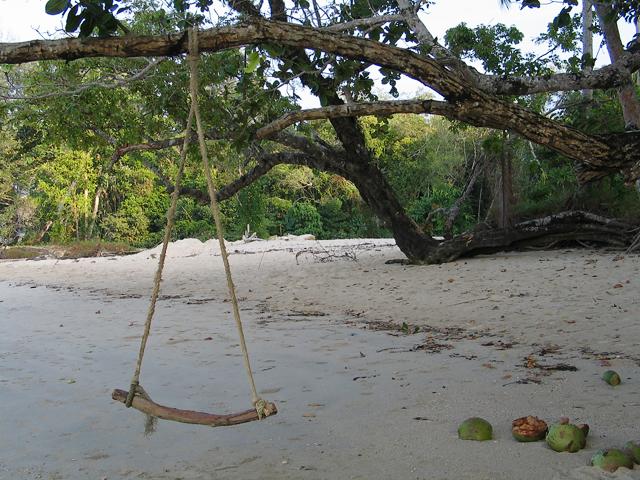 We have set out a little late and it is getting dark; there is not much of a sunset. We carry on and come to an even more deserted part of the beach with sheer cliffs on our left. We see lights twinkling amongst the trees. They come from wooden chalets on stilts, built in the old tradition of South East Asia. 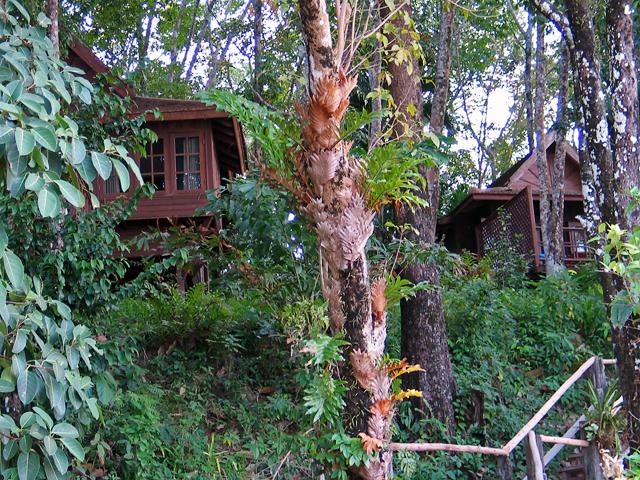 We decide to walk up the old part-wood, part-stone steps to what we think is a village. 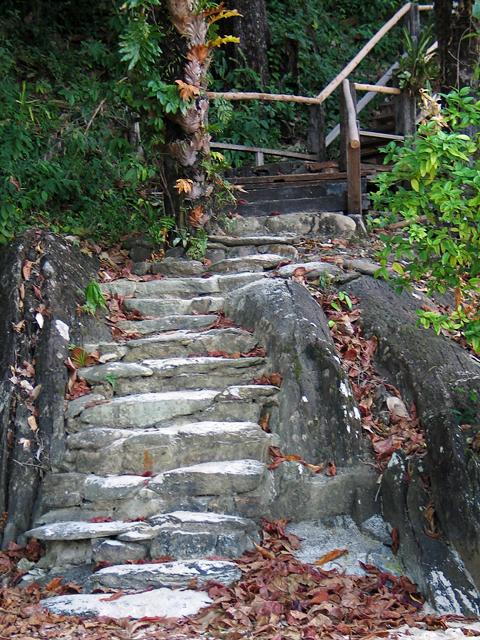 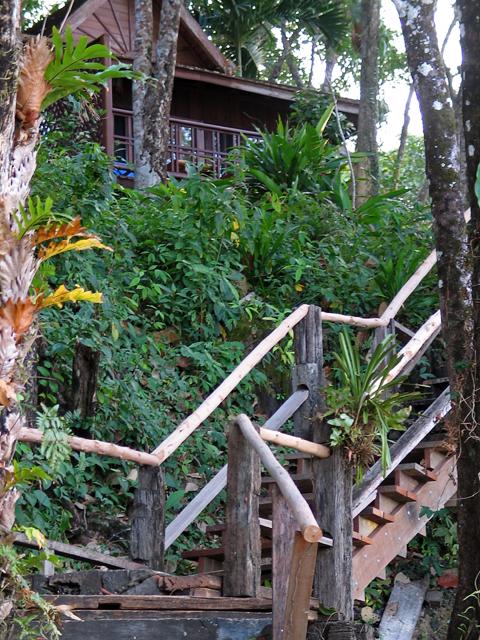 When we reach the top we turn around to a magnificent scene below us. There is just a hint of a moon in the dark sky. The sea stretches out in calm rhythmic ripples, lapping at the long white beach that leads into the distance to the right and to the left, broken only by some rocky outcrops in places. What the steps lead us to is indeed a village, a village of surprises. On the promontory is a wooden structure, a library open on all sides, offering a 360-degree view. There is a maze of wooden buildings, chalets on stilts, a reception centre, a dining chalet and a larger foyer. It is the Similana Resort. Little did we know then that we would be back in this resort within a couple of days and meet the dogs again. We get directions from the lady at reception on how to get back to our hotel by road. We take the red sand path she points us to. Night has come. The moon is bright now and lights our walk. There is no other light. 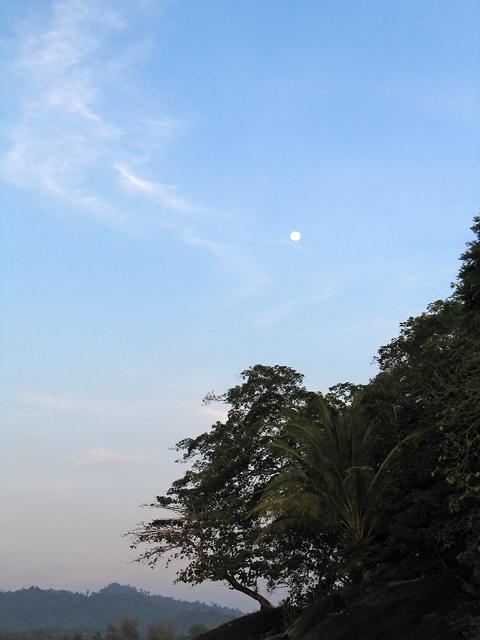 The path brings us, half a kilometre later, to the main road. We pass a few dimly lit homes before we come to our hotel gate another kilometre away. Near the gate, a small, well-lit grocery store is open and Don browses and gets some snacks. The people who run the shop and a few of their friends sit outside. They look less Thai to me than the northerners do. They look like Malays and I am tempted to speak to them in Malay. 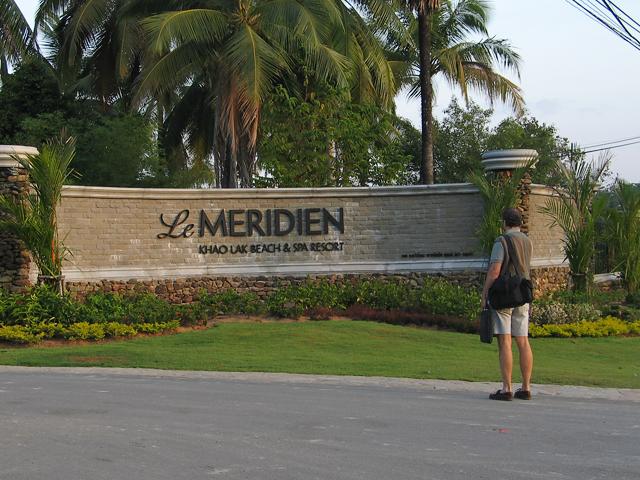 From the gate it is another long walk of a kilometre or more to Le Meridien itself. The road is flanked on both sides by palm trees and miniature gardens and orchids that we had not noticed on our trip in by limousine but are now able to admire more leisurely. There are spotlights hidden in the bushes and fairy lights woven into the large trees. From time to time we pass little grottos of Thai garden sculpture or a spirit house with a fresh offering of flowers, fruit and water. The narrow sidewalk is well-paved. Though extremely tired, we are renewed by the beauty and peace of this walk. That night we dine at the Baan Thai, the Thai village-style restaurant at the resort and are impressed with the décor and the outdoor setting. We are given a table for two in a small gazebo by the water-lily pool. The sound of miniature waterfalls and fountains and the croaking of a variety of frogs accompanied by a lone man playing a xylophone reminds us of Bali. We order our food and to the surprise of the waiter we ask for “extra spicy.” We are happy -- it is genuine Thai food and not an imitation for the tourists. We couldn’t have asked for a more perfect night!  Late nights and late mornings are a habit of our holidays. It is a leisurely start for us. We go down to breakfast with our cameras with a view to taking photos of the magnificent grounds and pools and flowers. Before breakfast/brunch we manage to capture only a couple of scenes and those only from the breakfast table. 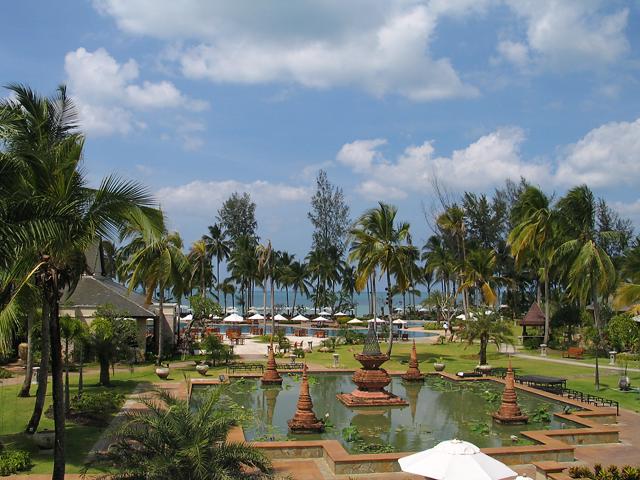 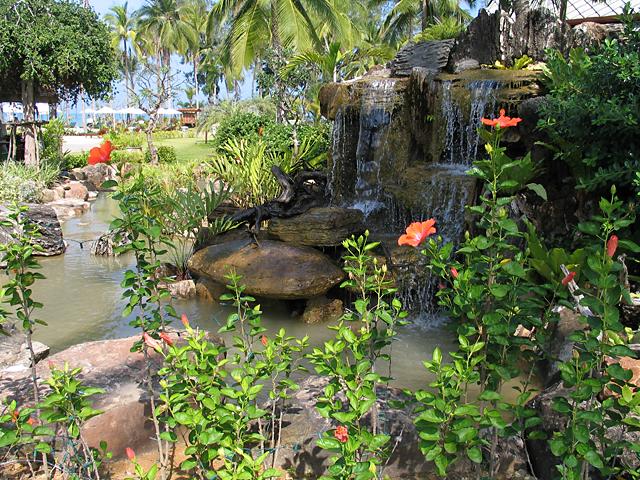 Chocolate Ice cream for starters! 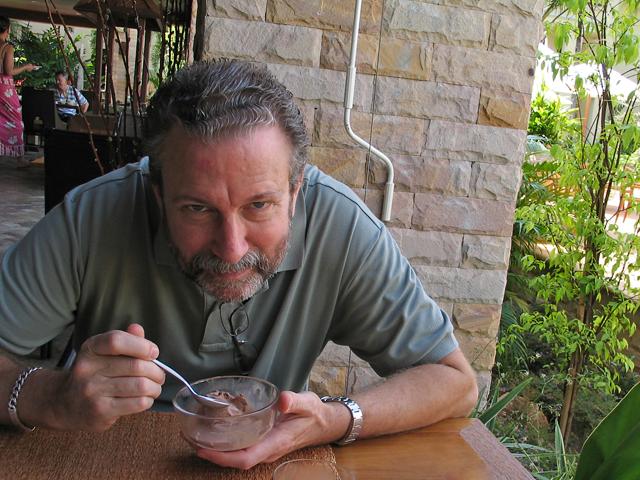 Brunch is excellent. Plenty of well-prepared dishes for the carnivores and, what is even more wonderful, there are many Asian vegetarian dishes for me. The waiters serving us are pleased to see me enjoy the spicy food. The long feast and sea breezes and warmth of the clear day soon get to me. Not being a lover of the noonday sun I am in no mood to wander around photographing or even to sit on the beach to read. It's too hot. We retire to our suite. I sit on the balcony to read my Piano Teacher. Don strips off and gets into swim briefs (very), gathers his suntan oil and book and goes off to tan by the small pool right below our balcony. 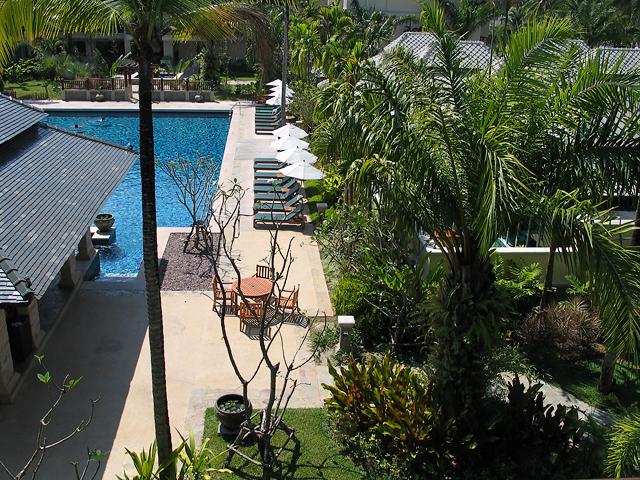 It becomes our private pool. Only one other couple seems to use this pool. Families prefer the larger one by the sea and the beach and the fun and games. Don takes longer than he should with his browning time and comes back roasted and reeking of carrot oil. After one of his power showers we head out to the same beach as the evening before. We are earlier this time and hope to catch the sunset. Yes, the cicadas soon start up. And the tide is low. 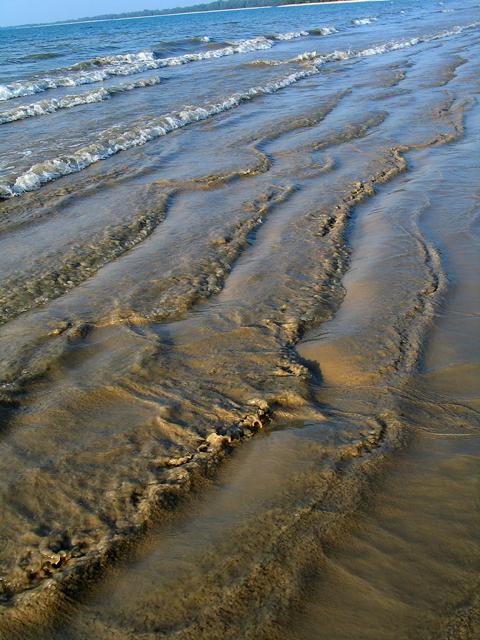 This area abounds in different varieties of crabs. We photograph the elaborate designs created by large crabs. Hearing our footfalls, they scurry into their homes. 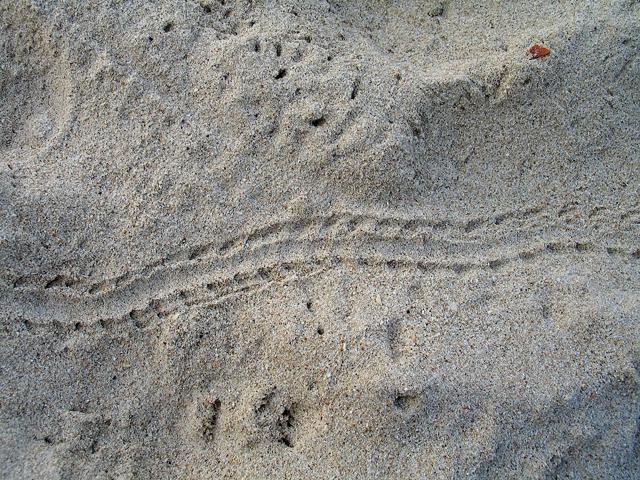 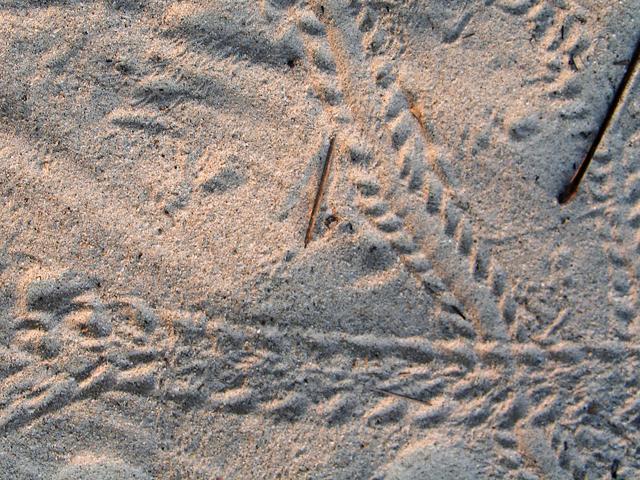 We photograph the complex structures of the sand crabs as they fling little globs of wet sand out when burrowing to make their homes. 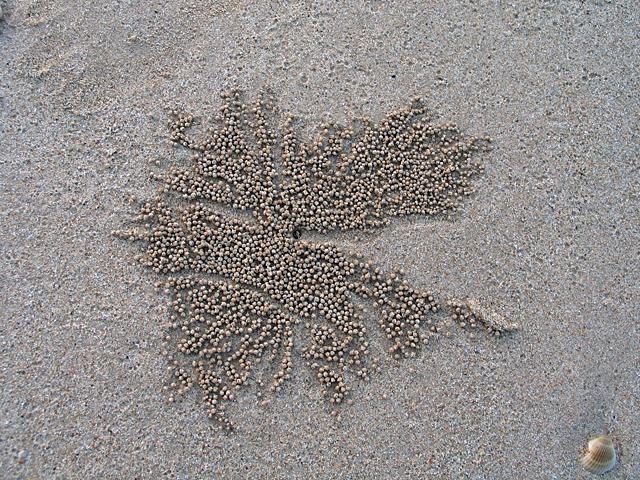 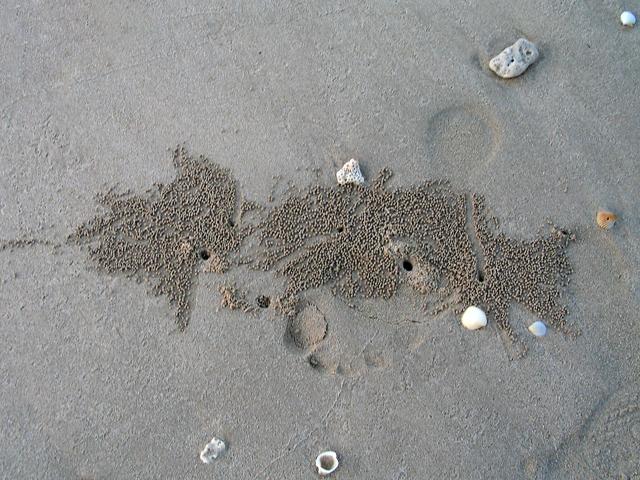 We meet the three dogs from the night before with two of their friends. They follow us for a short while. We move on to a rockier part of the beach -- such interesting shapes of rocks here. 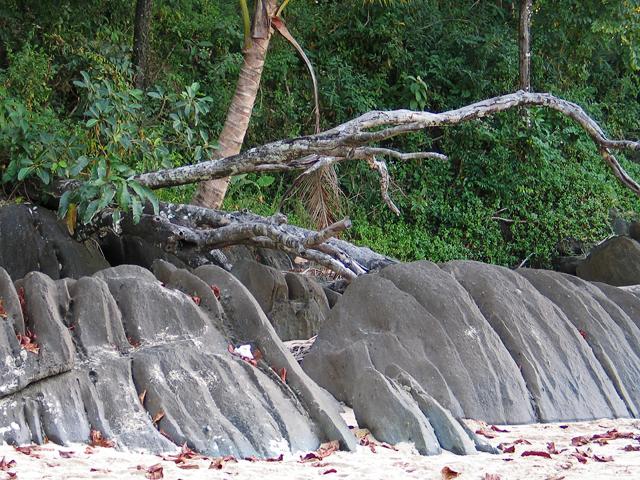 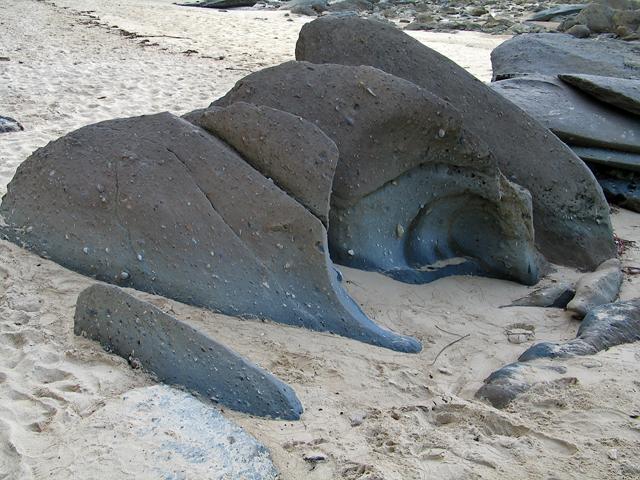 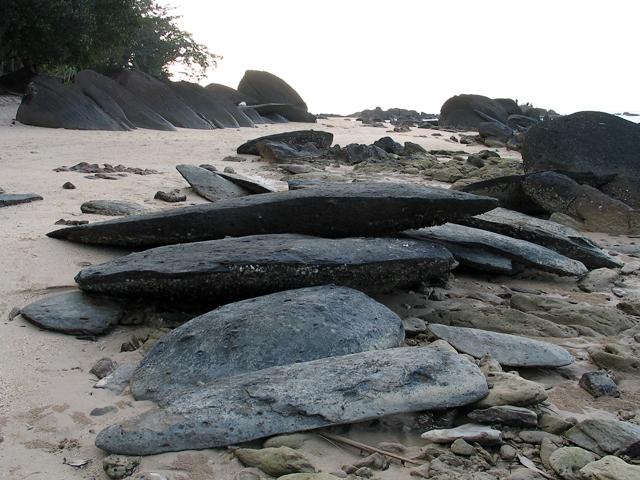 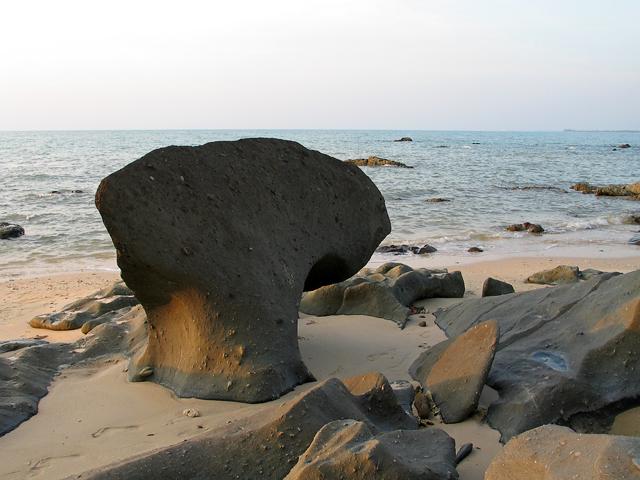 Some grey outcrops remind me of families of whales -- fathers, mothers and children. 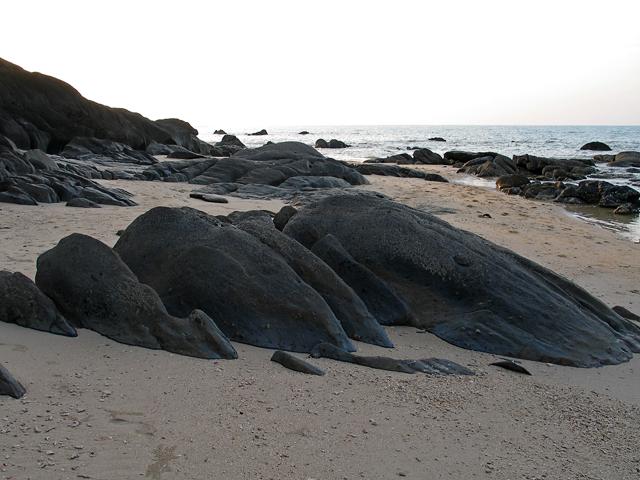 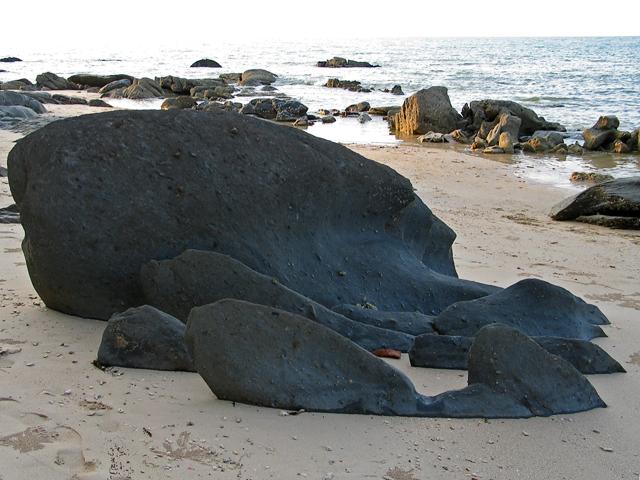 We chance upon a couple of spirit houses on the tidal rocks. 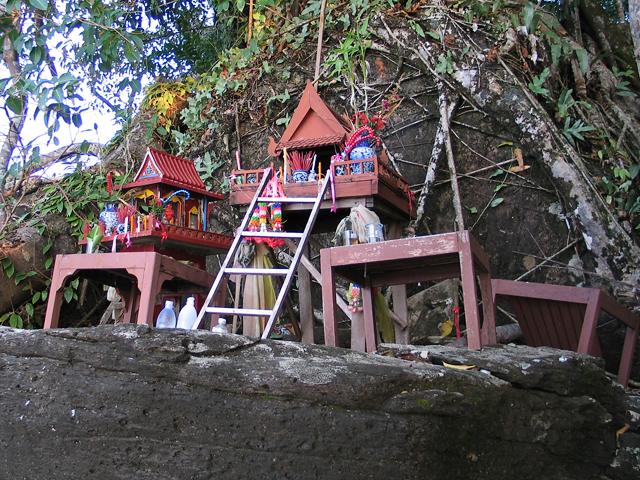 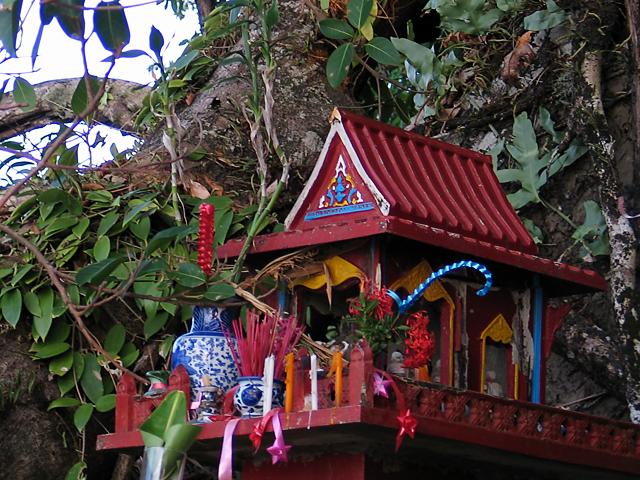 A few anglers are on a large outcrop of rocks a few metres out to sea. They wave and shout greetings. 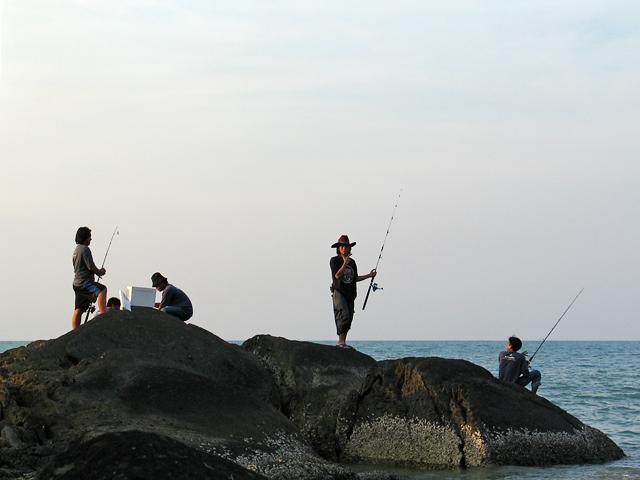 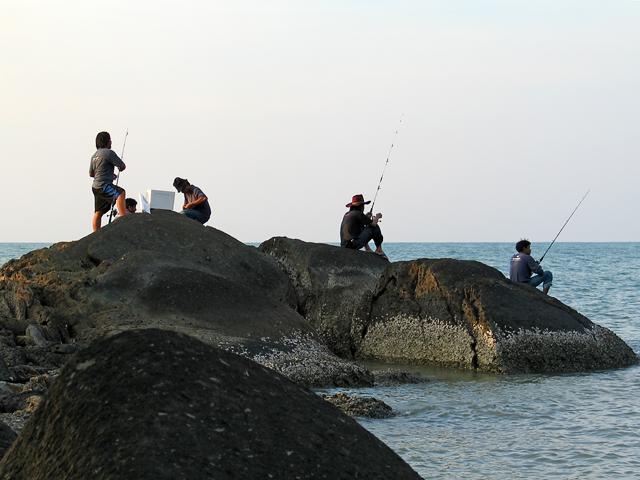 We'd hoped for a good sunset and are rewarded. We get a splendid display. 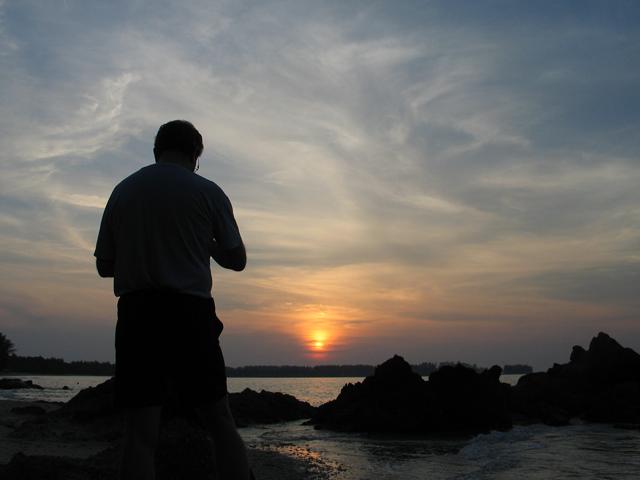 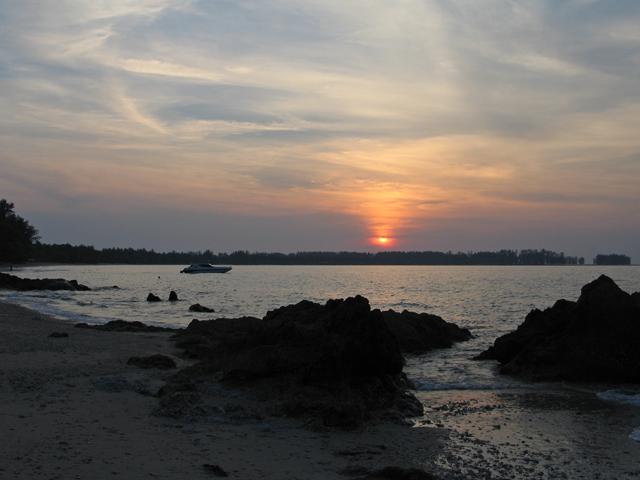 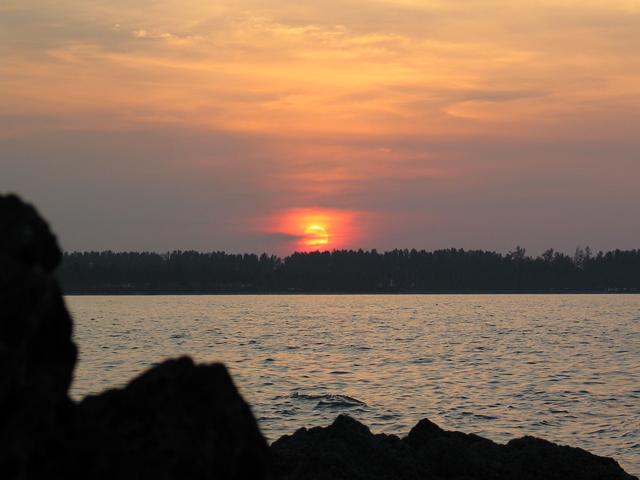 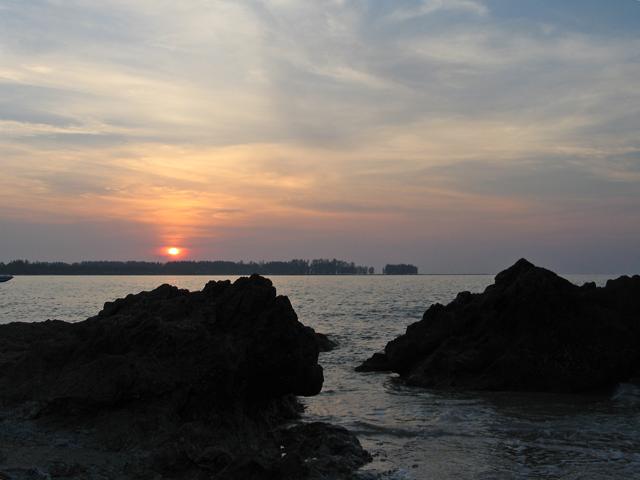 We get some excellent shots before the glow of the evening disappears with the sun into the western horizon. The sharp moon rises and we meet the anglers leaving for the night and I ask them how successful they've been and they show me their empty baskets. When I say to them "bright moon, hard to get fish” they echo the sentiment. Fish do not come close to the shore during a full moon. I learnt this from my father, not a fisherman. I chat about night fishing and hunting crabs and we talk about shore crabs having no meat in them at full moon. The men are pleased with my knowledge and take me to be a fisherwoman at heart. “See you tomorrow,” we shout to each other as they wander off. Don and I walk on. From beyond the high rock promontory comes loud music. Curious we climb the rocks and on to the other side. We find workers setting up an exclusive outdoor dining area for Christmas Eve at the Similana Resort. The trees are strung with fairy lights, tables are set with tablecloths, flowers and candles -- a romantic dining setting on the beach, with white sand underfoot, the moon above and the sound of waves should there be a lull in piped music. By now we had walked quite a ways from our hotel and we turn back. The cicadas have ceased and the silence is eerie and uncomfortable. The moon is very bright in the clear, cloudless sky -- the white sand is whiter reflected in the glow. We talk of the pleasures of owning a bungalow on the beach; I once lived in one in Batu Ferringhi. I tell Don how in March every year the tide would be at its highest. The waves would come to the steps of our patio, just a couple of metres away from our living room. We decide a home on a cliff would be much more exciting, with views of the sun and moon rising and setting. When we arrive at the hotel we find the beach and gardens and pools empty. 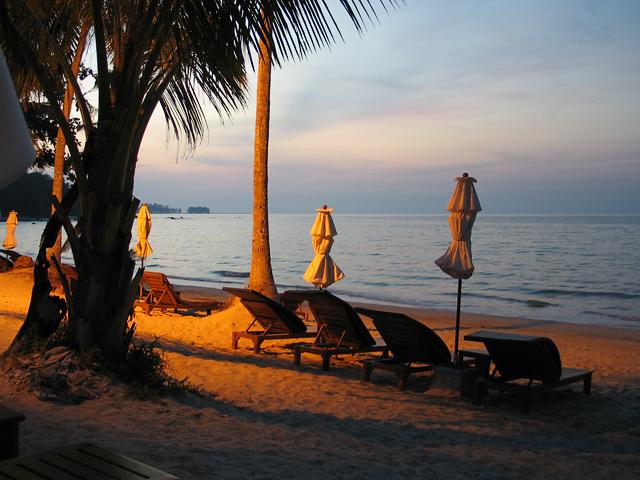 Families have left to get ready for the Christmas Eve functions in the various resort restaurants. Beach attendants have cleaned up the place and put away beach towels, cushions, chairs and sun umbrellas. The pools are lit up seemingly for the two of us. Here and there, discreet and quiet, stands a security guard who is armed with nothing more lethal than a flashlight. The air is filled with the swish of waves and the perfume of night blossoms. The gardens are fairytale-like with subdued lights in the bushes. The night is transcendent. 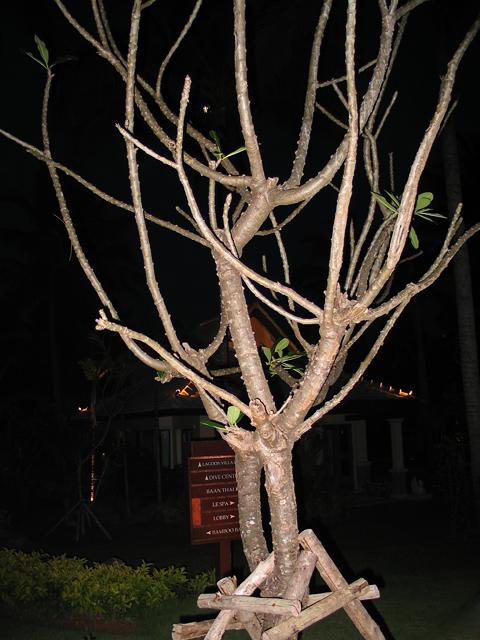 On arrival at our suite we decide to relax and not to take part in the Christmas festivities arranged for the evening. We sit on our balcony listening to music from the revellers wafting our way from time to time. As we prepare to go to bed, I look up from the balcony and see what at first looks like stars, but rising from the hotel grounds. There is scattering of gold lanterns floating up into the dark sky. 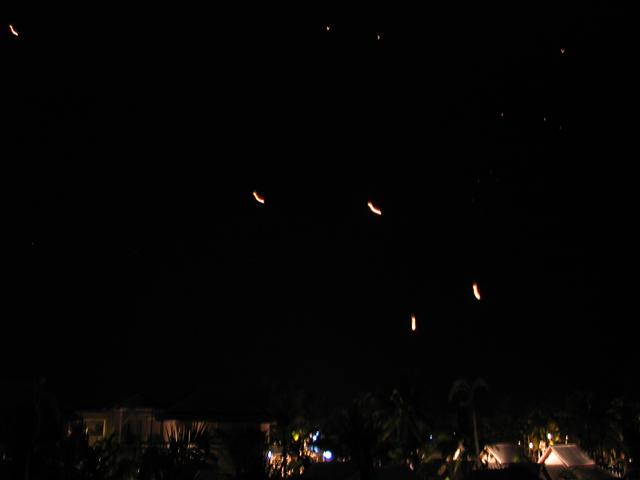 Don and I get back into our shorts, grab our cameras and race to the area where we saw the lanterns being released. We get there just in time. A stream of gold lanterns are released -- Khoom Fay, traditional two-metre-long lanterns made from tissue paper and bamboo. Burning wicks soaked in oil lift the gauzy lanterns up. 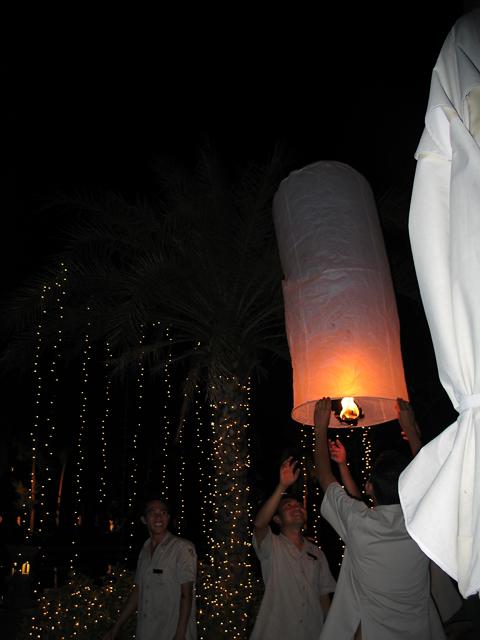 Guests write messages of good wishes and peace and prayers on the paper lanterns before setting them off. 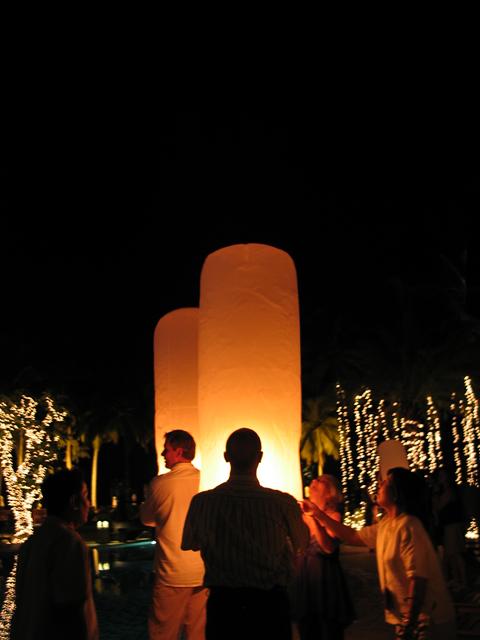 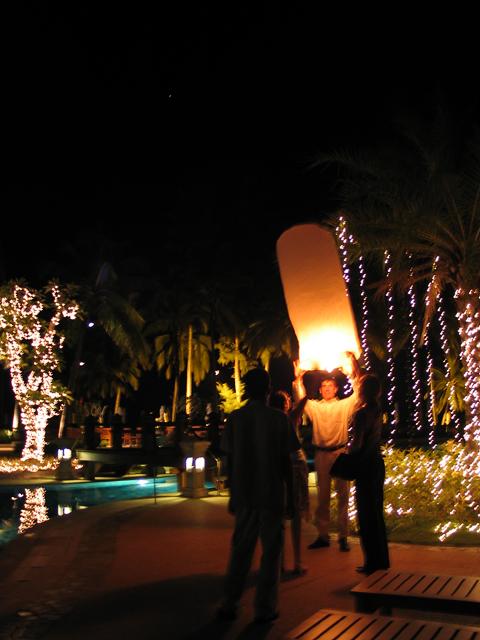 As they ascend gracefully, they form an amazing sight, especially as they are released in small batches at regular intervals to form a chain of lights. They rise and drift and float upwards into the calm night sky and remain visible like moving stars going a long way into the sky before completely disappearing. 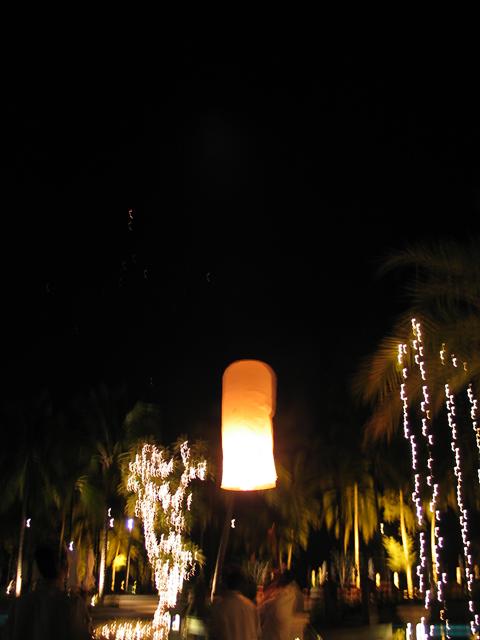 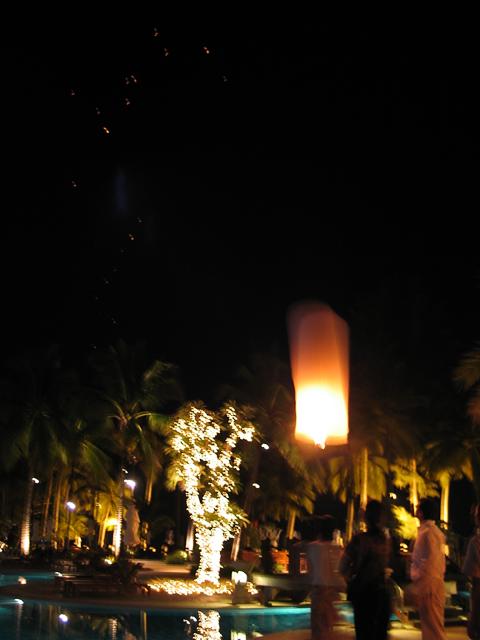 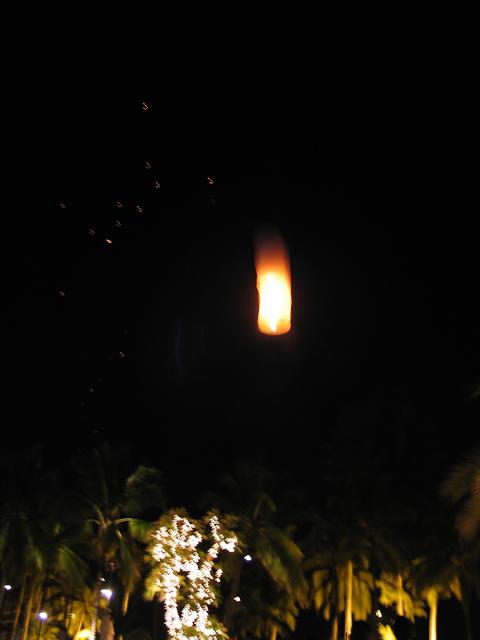 After the excitement of the hot air balloons is over, I am hooked and want to join the revellers. Don pouts a little and scowls a lot and goes back to change to evening wear. I keep a table for us; he takes much longer than I expect. He gets back looking pretty dapper in his black tuck-pleated Indian kurta and black jeans. Fortunately, I did not give in to getting picked up; he was worth the wait. I go to our suite and change into my red Chinese jacket and black slacks. “The Star Band” from America is in full swing. We sit outdoors and enjoy the music and drinks. A few people step onto the newly erected wooden dance floor. After a half hour of coaxing I manage to get Don to dance. “The music is not to my taste” is his usual excuse for not wanting to dance. The music is not to his taste this time either. We disco till the party comes to an end and the musicians put away their instruments for the night. The revellers reluctantly dribble off. 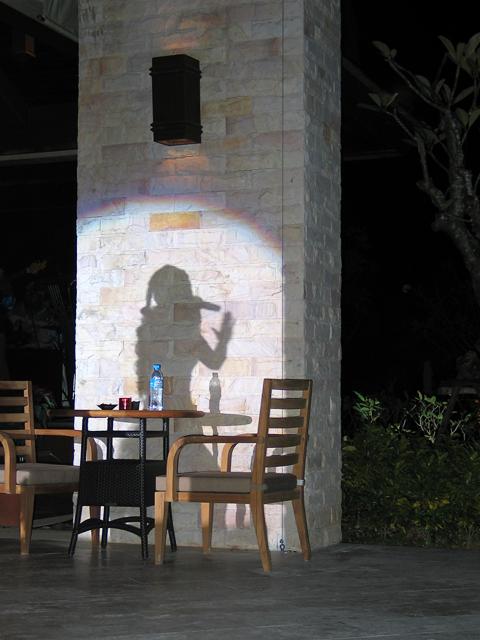 We plan our next day. We decide to start early and walk down the beach to the right of the hotel. To get there we will have to negotiate a rivulet that runs off the beach parallel to the hotel. I had seen a few small village houses on this waterfront; and some hens and a couple of magnificent cockerels scratching around. I was eager to get some photos to add to our collection of cockerel photos. Before we go to bed, we call our daughter Shanta and family in England to wish them a Merry Christmas. We don't really chat as she is busy preparing for a family party. I tell her we are not in Phuket as I had previously told her, but in a place called Khao Lak. It is a fantastic holiday resort, up in the mountains, far from Phuket and all the wonderful shopping places. I can't remember why I tell her we are in the mountains when we are on the beach.  This day dawns like the others, cool and perfect. There is hardly any humidity today. We change our minds about the early morning chicken walk and decide to make a trip out instead. But after breakfast Don cannot resist the temptation of another tanning secession. He wants to look good for the girls in the office when he gets back to Hong Kong. We do the usual routine -- Don roasting by the pool and me on the balcony reading. After about an hour or so I decide to check out the boutiques in the hotel. These turn out to be nothing spectacular, or even stocking goods that appeal to me. I browse the Jim Thomson silk shop and the only item that catches my fancy is a black silk shirt with a bamboo design. There is an Australian lady in the shop trying to explain to the girls that she wants to buy two wooden curtain rods to use as handles, similar to the ones in the hotel suites. The girls do not understand so I intervene and explain a little more clearly to them. It turns out that she would be able to buy them in a houseware store and she says she will get them in Bangkok when she and her son go there in a couple of days. After Don’s power tan and power shower we set off to town in the hotel transport. Town turns out to be a miniscule village of souvenir shops... 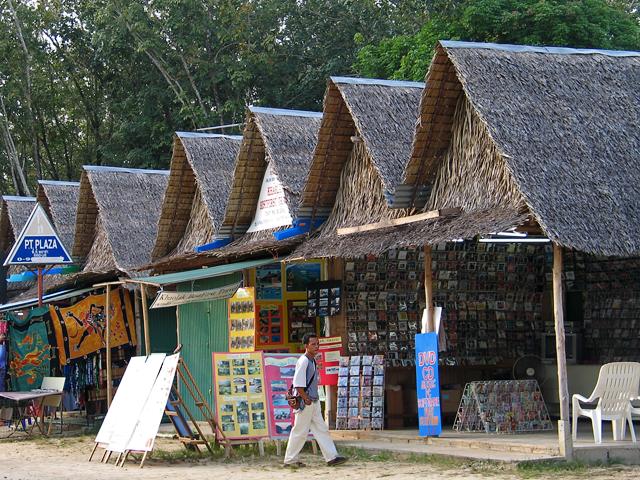 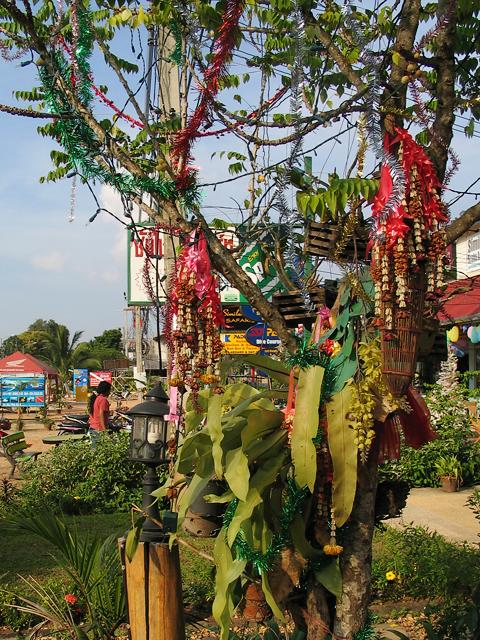 ...and exotically briefed dummies... 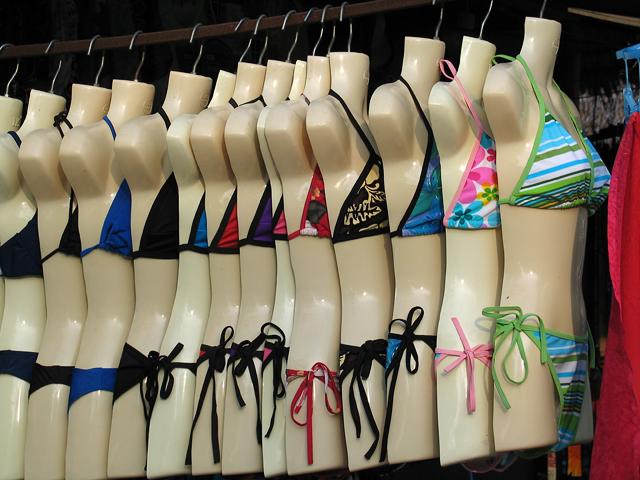 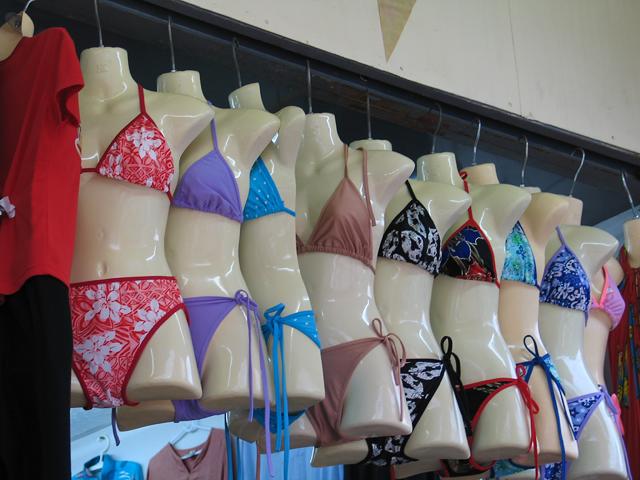 ...and restaurants... 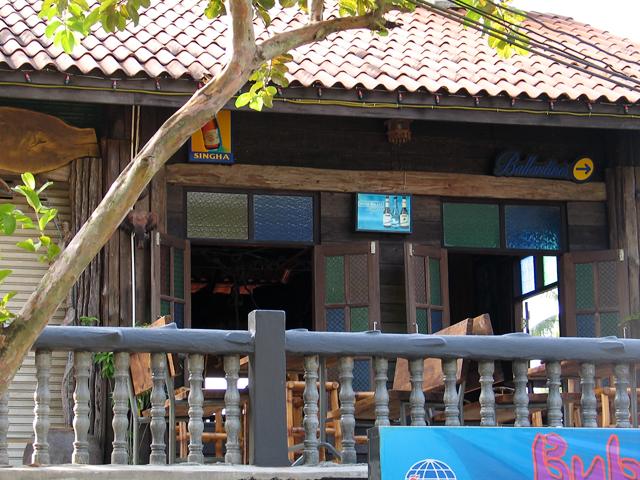 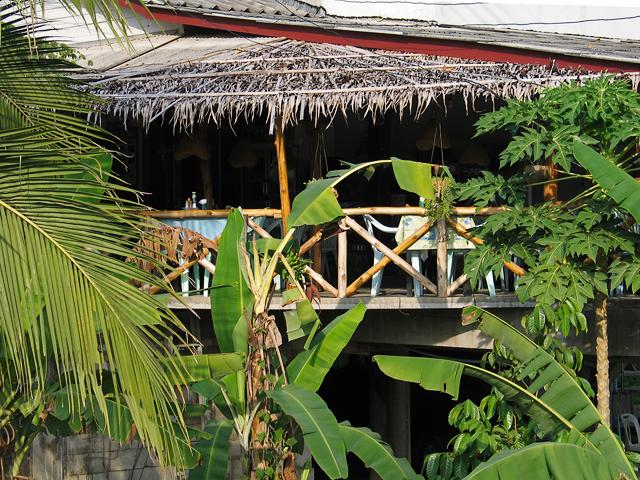 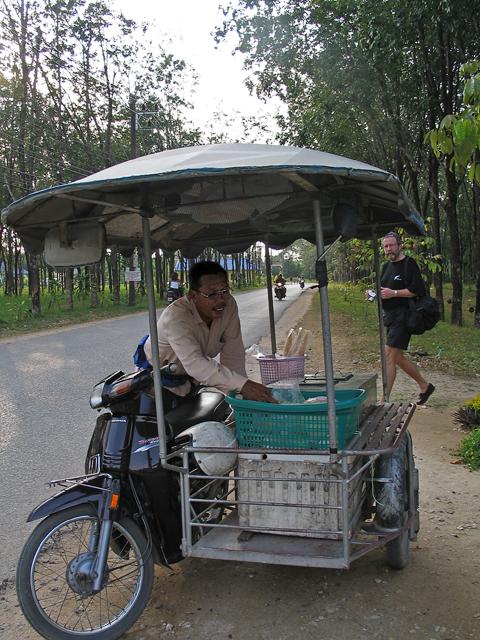 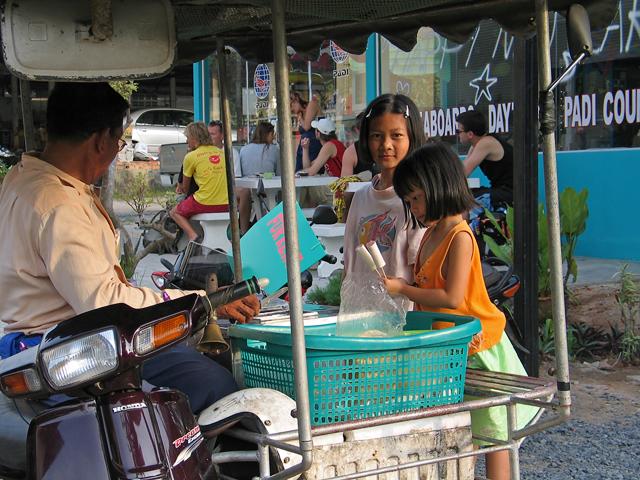 ...and diving tours. 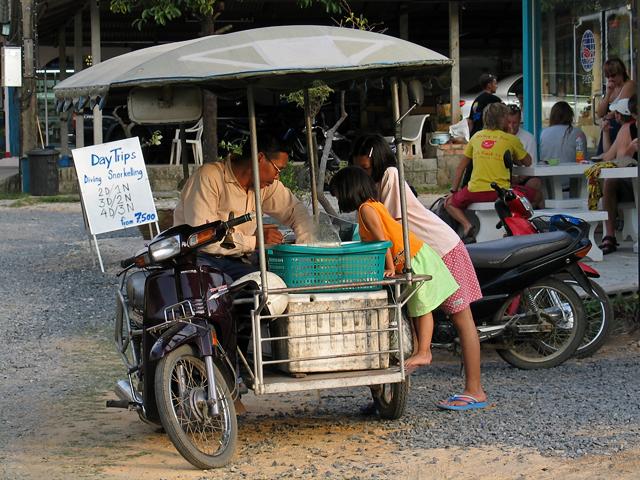 I soon find someone willing to take me diving. 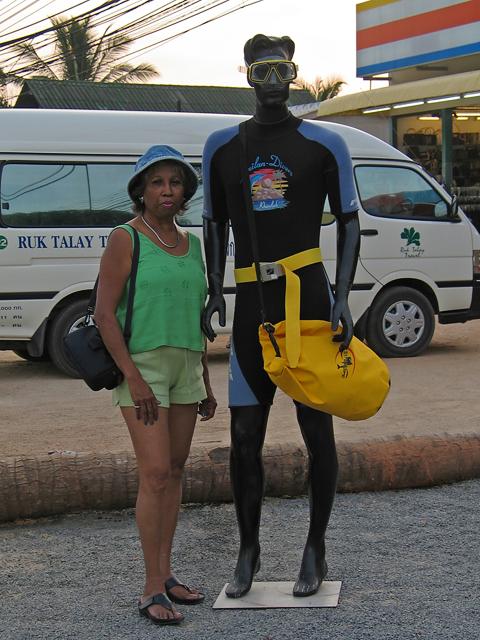 We walk about exploring a few side lanes to admire some of the lovely homes. 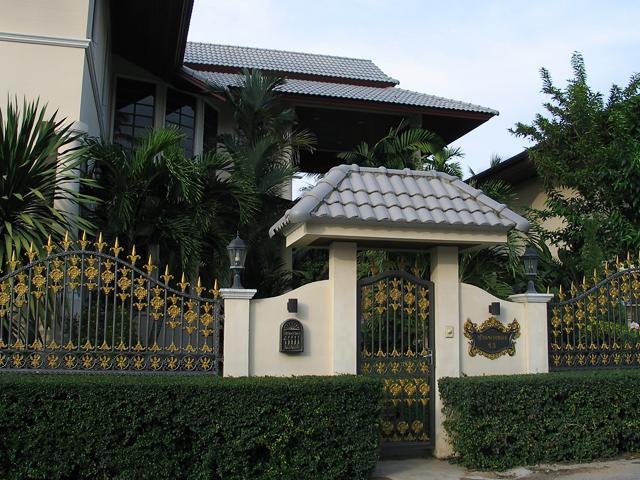 And get a taste of country life. 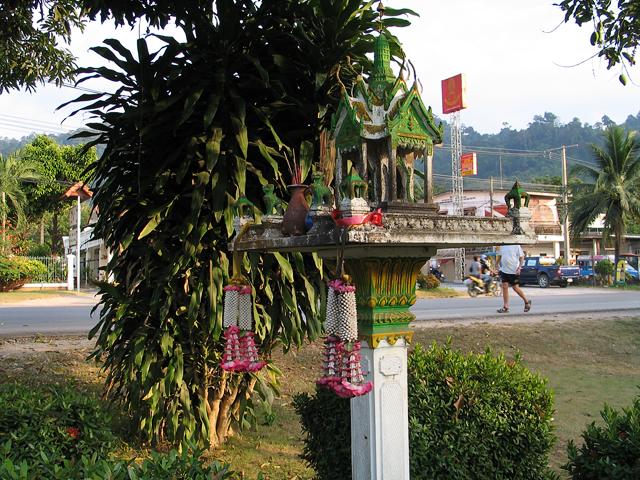 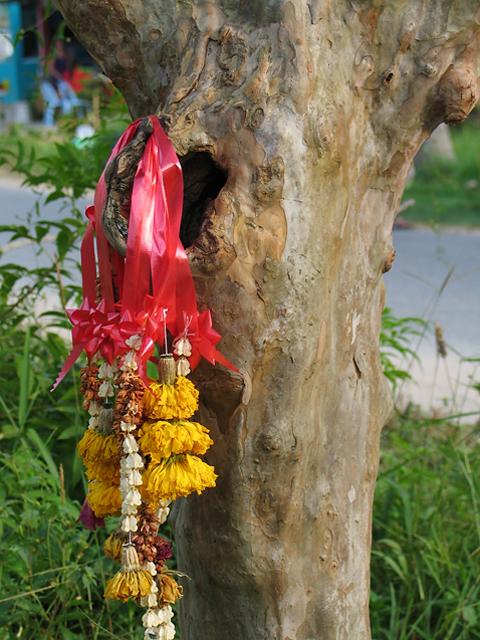 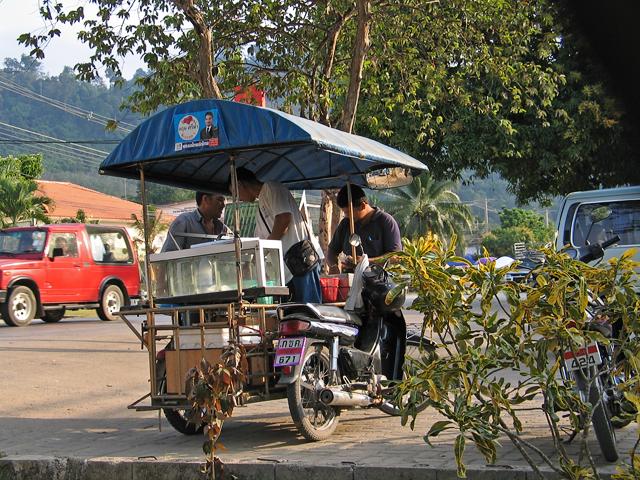 But we do not go too deep into the villages which lead to the beach. As evening comes, a few strings of coloured lights blink on, the only thing that is remotely Christmasy for many of the tourists, but they are happy browsing the bargains. Of the many western tourists, there seems to be hardly anyone from an English-speaking country. Everyone we meet speaks in a European tongue. We walk around the souvenir shops. Nothing much appeals to us except a stall displaying a large variety of shells. We purchase two sets of kapis shell wind chimes and a few medium-sized shells for our bathroom collection. We had walked for two hours and decide to have dinner in town in one of the rustic-looking Thai restaurants. We have an excellent meal of our favourites -- squid salad for Don and we share a vegetarian meal of water spinach and very spicy green papaya salad. We complete our meal with fresh coconut water for me and tonic water with plenty of fresh lime juice, not the bottled chemical lime juice, for Don. Night life is pretty quiet, none of the hustle and bustle of the night markets in other Thai cities, but I am surprised to see a mobile Automatic Teller Machine. 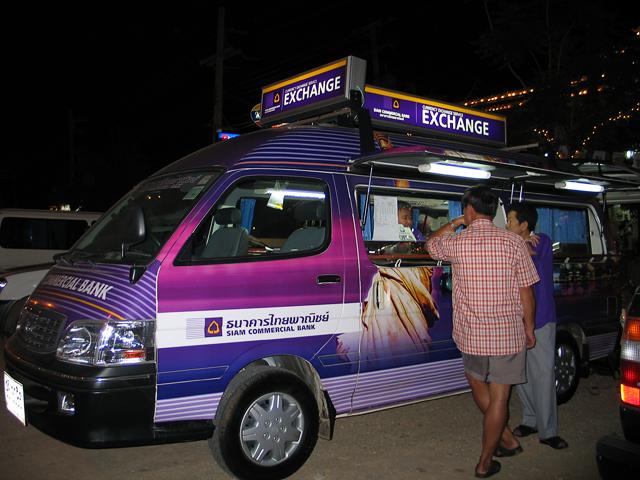 Based on this evidence, we decide there must some serious night life here that we’re not aware of. Soon the hotel van comes for us and it fills up with Continentals from our hotel. We settle in for the short ride and are amused by the excitement of foreign tourists showing-and-telling their purchases.  Boxing Day, so-called because it’s the day we box Christmas gifts for those who provide services. On this day we get our own boxed gift -- we get to stay alive. Boxing Day was a late morning for everyone except perhaps the parents of very young children. Though we had not gone to sleep until the early hours of the morning we were relaxed enough for me to want to be out and about by 7am or so. I lay awake for a while planning the day. This would be the day we would investigate the beach on the other side of the hotel, the one to the right, a much waited for adventure. I am about to wake Don when the bed shakes a little. Then the tremor happens again. I give Don a poke and say, "Stop it." "Stop what?" he says. "Stop shaking the bed." "I'm not shaking the bed." "So, it’s an earthquake, I suppose." "Yes," he says and turns over and goes back to sleep. I go "Yeah, yeah," but he means it. Having lived in California he is used to earth tremors. I was only joking. I am now sure it is a vibrating bed that nobody had told us about and I’m grumbling that there should at least be a brochure about it. I set about looking for a switch that will turn the tremors off. Not finding one I give up the search. The tremors stop. Eventually we venture out and go down for brunch. On our way to the terrace for breakfast we walk past the gym where two ladies are doing their morning run on treadmills and a couple of muscular young men are lifting weights. Some of the early-risers have already left on the morning dive tour. The beach isn't too crowded this morning but there are several families with children, as well as sunbathers catching up on their tanning and holiday reading. Younger children and babies are in the crèche, allowing parents a couple of free hours to themselves. The beach boys and other staff are out there attending to the needs of the guests. We choose our favourite breakfast corner at Bangsak Grill on the patio by the umbrellas. 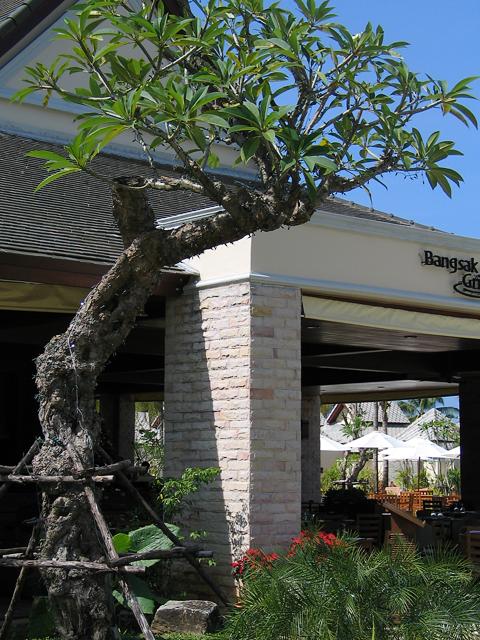 The patio is set back a hundred or so metres from the sand that slopes down to the sea. 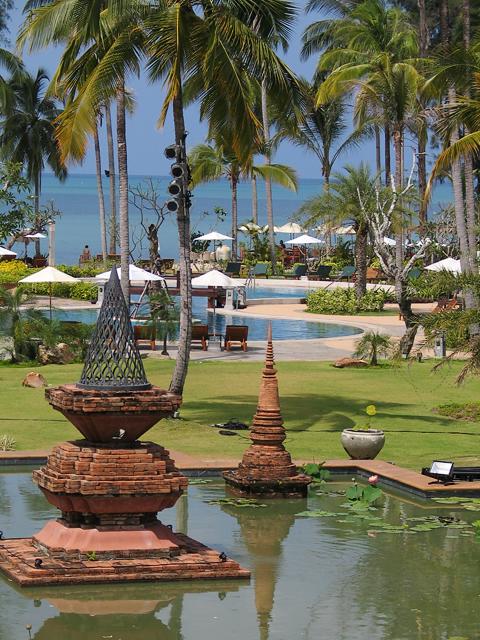 The lotus pond and the main fountain separate us from the beach. A team of workers has pumped the water from the pond and are busy carting away loads of mud from the bottom of the pond. Soon the blue-clad workers march away towards the beach to do some other cleaning job. We settle in for breakfast. Don and I sit facing each other with the beach to my right. It is a clear and calm day. Everyone is flush with goodwill, having celebrated a good Christmas vacation, and many of us have also come to the last day or two of our holiday. The temperature could not have been better, cool though the sun is bright. The air is permeated with the perfume of frangipani and pandan. We had paid no heed to what could have been our warning -- the intermittent mild tremors early that morning. Many did not feel it, while others turned over and went back to sleep before waking up for brunch. After our first course, and just before we are ready to go back inside to the buffet, a mother comes running from the beach towards the hotel with a young child in her arms and I imagine a quick nappy change. Then, close behind her, another lady runs with a baby. This is what I see behind Don. Behind me, Don sees a man running from the beach towards us with a camera followed by other people running. Don thinks that there is probably a celebrity in the foyer. I turn around to look behind me and see this crowd of people running, including many of the blue-clad workers. Most of the people are laughing as they run towards us. I think perhaps there is a shark attack, but why are they laughing? As I turn back I see to my right a wall of roiling sea. Churning grey mud and froth rushes towards us. Guests and staff are running in all directions now, away from the water. It is too surreal. Only the night before I'd been discussing the movie The Day after Tomorrow with a guest and for a few long seconds I am in the movie. I shout, "Don, run!" and stand up, quite calm, bend down and pick up my camera and bag from the floor. I see Don about to move towards me; he looks confused. I say, "Grab your cameras!" He turns around and picks up his camera bag and just as we move away I turn back and look at our table and see my favourite denim hat and Elfriede Jelinek's The Piano Teacher. I know I have time to pick them up. My right hand goes to them, but it is as if I say, "No, must leave them behind." Don says, "To the staircase." We run together. Just by the staircase a hotel worker in blue falls and no one helps him, no one trips over him. The rushing mass of people avoids him and runs past. He picks himself up and I see panic on his face. He runs up. Just then I see Don is in front of me, partway up the stairs. A crowd separates us. "Why is he not holding my hand? How did we get separated?" These thoughts occur but I also amazed at how calm I am. Don and I and the rest reach the top of the stairs, the first landing. I do not turn back to see if everyone behind us has made it. Within seconds the giant wave blows through the terrace where we'd been sitting, crashes against the building and floods the ground floor, reaching the ceiling of the ground floor. Tables and chairs, decorative screens, buffet layout and remaining staff all disappear. We watch in awe. From the landing I look at the spot where we had been sitting and all I see is a wave of grey mud; the dining room is under water. There is floating debris everywhere and I look to see if my hat and book are in the flotsam. 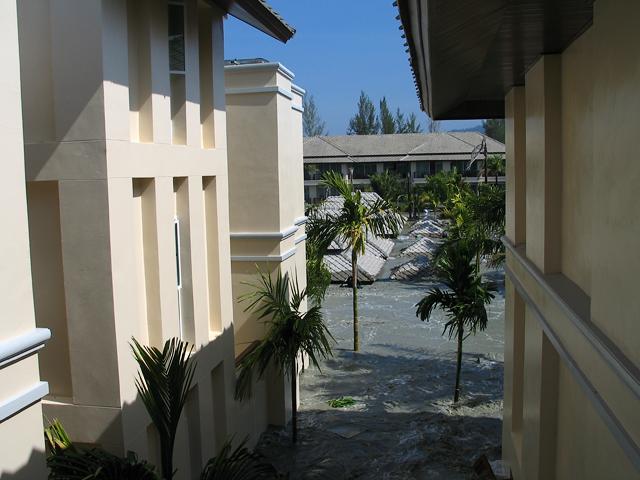 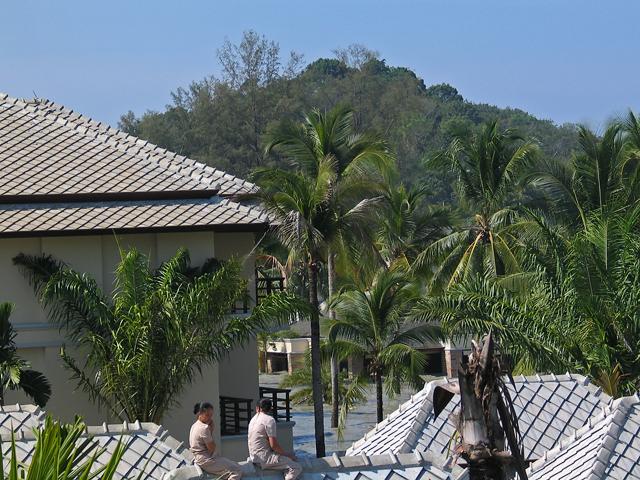 Those who escaped stand around stunned and dazed, a fatal frieze. 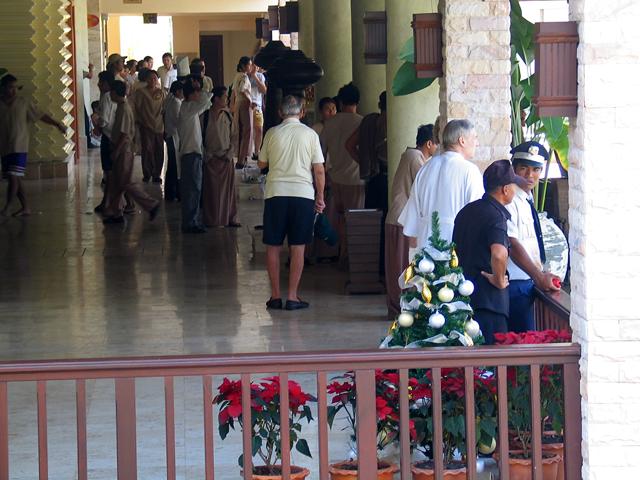 For what seems like a long time, a shocked, heavy silence hangs in the air. The currents swirl around. And then, as if on cue, everyone starts moving, running, shouting, calling for friends and relatives, crying. It is like a movie that is stopped for a few seconds and started again. There are heartrending cries and screams and guests and workers run along the corridors and into the rooms of the first and second floors shouting and calling out for family and friends. Some hang over the balconies shouting out names into the churning muddy water, a monster quietly digesting its victims. Don stands there fascinated and then he tries to pull out his camera. I say, "We must go higher up." and detect a crack in my voice. We go to the second floor. I keep repeating, "Oh, no, oh, no," and "Why? Why?" as if Don knows the answers. The wave has smashed through the sliding glass doors of all the ground-floor rooms, destroying everything before it, and finally retreats, sucking people and property back out to sea with the same force as when it raced in. It returns to sea level, leaving behind a flood of mud and debris and destruction. Mattresses, sofas, cabinets and suitcases float away. As the architecture of the building is open plan with glass walls, everything outside is clearly visible. 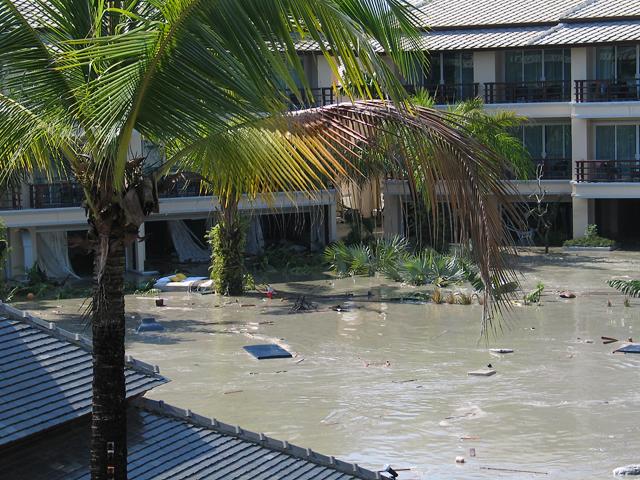 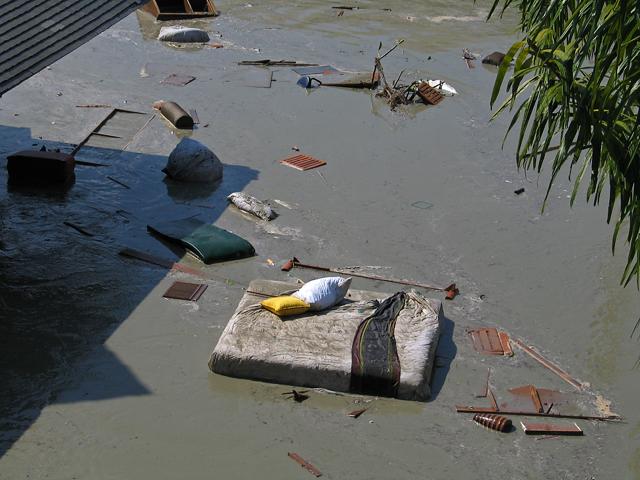 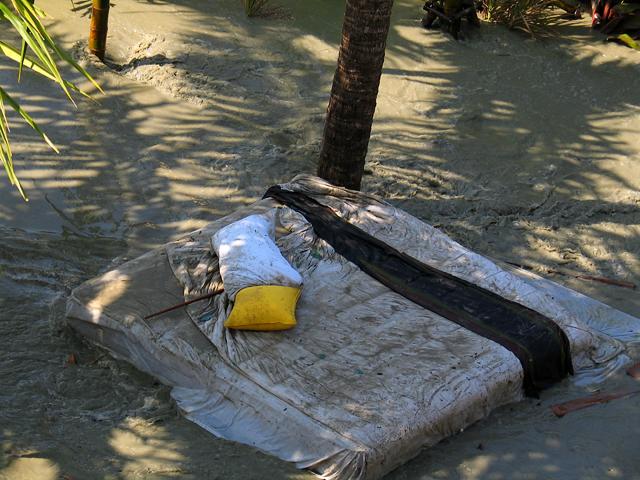 Now that the wave has receded I see our breakfast nook. A wooden wall lies on our table, everyone and everything gone. 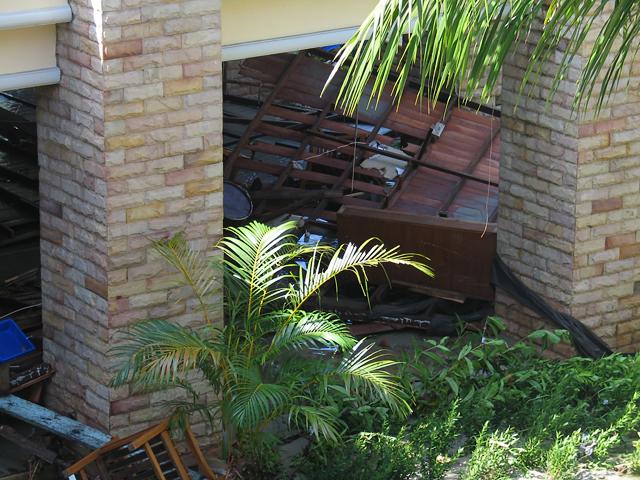 I look down at the receding slurry with voyeuristic fascination. I think I should see bodies floating. I see none. I get my camera but my hands shake. I take more pictures of the flood and sob at the same time, more like hiccups, tearless sobs. Don is busy. He tries to comfort me but he also needs those award-winning photos. We had the advantage of perhaps ten seconds of warning -- people indoors never saw the tsunami coming. Late sleepers, children in crèches, sunbathers, swimmers, beach boys and divers, all are gone in just under a minute. There was no escape for staff on the ground floor, the kitchen staff, the girls and boys doing room service, and those on the ground floor still in their rooms, mostly families that did not see the salty mud wave coming. People unaware of their injuries walk around trailing blood; others try to bash in locked electronic doors to retrieve family members -- their door cards no longer work without electricity. No telephones or mobile phones work. Those who fled to the first and second floor rooms almost immediately are lucky; they are able to open their rooms and their safes before the back-up generator cuts out. We were lucky enough get to our second floor suite in time to open our door and safe before the electrical system got swallowed up. Survivors from the outdoors are in their swimwear. Those who escaped their ground-floor rooms had to flee without their essentials -- clothes, passports, money and credit cards. The small village on the other side of the hotel, on the beach we would have been on had we completed our breakfast a little earlier, is just a mud pool. All that is left of people’s lives is a wooden headboard leaning against a coconut palm. 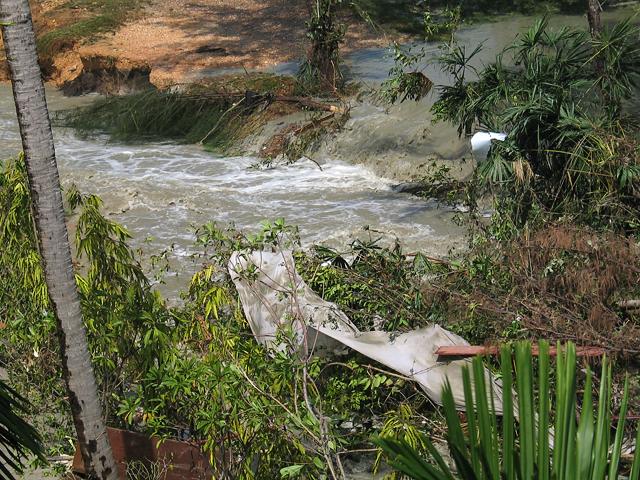 On this side of the hotel were the tennis courts and the large car park with facilities for the chauffeurs. Cars and vans float about for a while until they come to rest against something bigger than themselves. There is no sign of life -- chauffeurs waiting by their cars and drivers waiting to be called have been washed away. 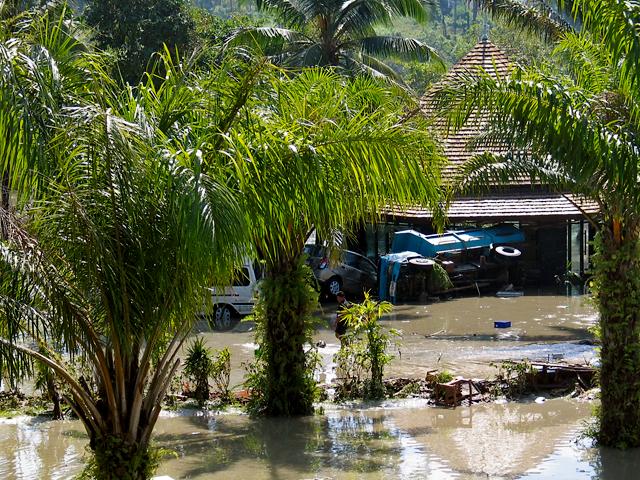 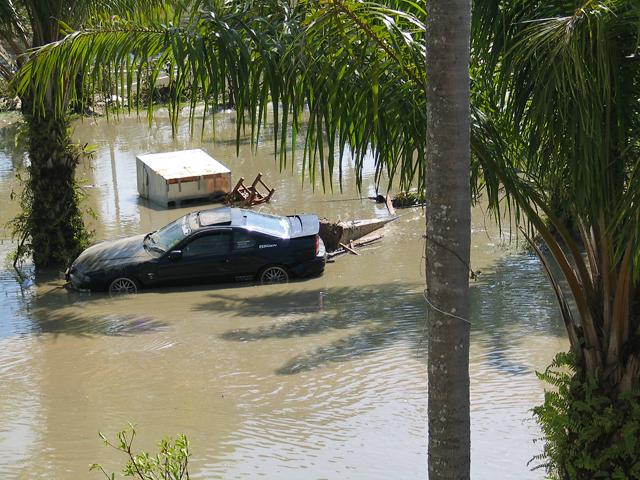 My first conscious thought of the outside world is of my sister and our neighbours and friends in Hong Kong. They would be watching the news on TV in real time. I hope they do not hear of this disaster before we are able to tell them we are safe. Our daughter and her family in England will hear of it later, perhaps eight hours later. My mantra is "Please, please, do not let anyone watch TV." I even think it may not get reported as we are in such a remote place. We know nothing of what has happened in Phuket or elsewhere. There are many people standing around in the corridors. We invite them to come to our room if they need anything. I see a lady sitting on an ice chest and invite her and her son to come into our room. She turns out to be the lady I tried to help in the Jim Thompson shop the day before, Jean, a gracious and charming 82-year-old woman. Both mother and son are calm and pleasant. They are from the ground floor and they were on the beach when they saw the wave coming and ran to the hotel for safety. Fortunately, Peter was in a shirt and shorts and Jean in a blouse and swimwear. Unlike me, Jean managed to save her hat. I lend her a pair of my slacks; the rest of my wardrobe consists of shorts. The four of us in our room are pretty comfortable and we tease and joke, hiding the enormity of the tragedy. The suites, mostly family rooms on the ground floor, are completely gone. The water had reached the ceiling. 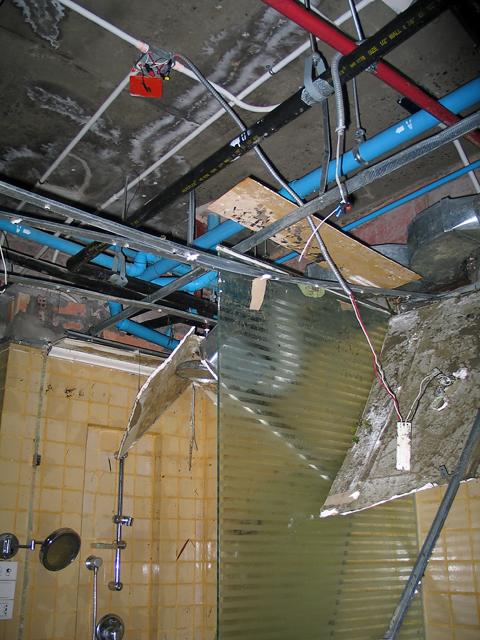 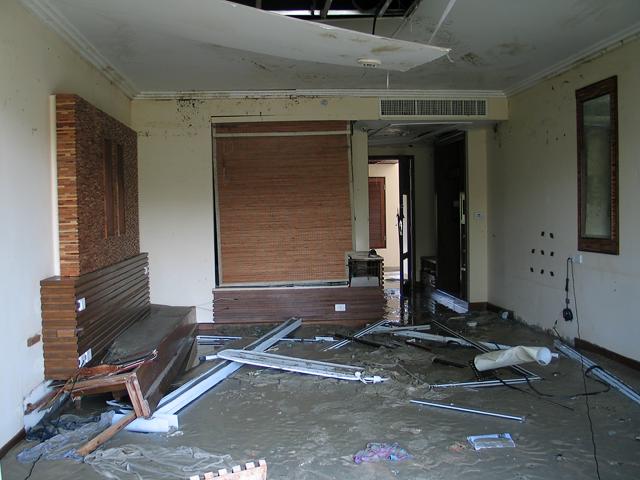 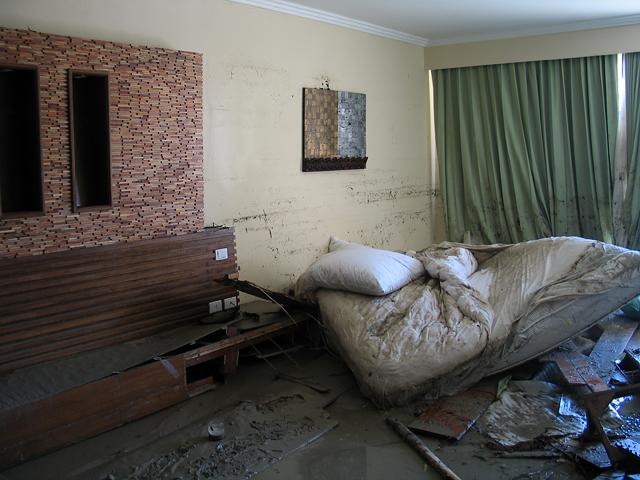 Most of the contents of the rooms were dragged out to sea by the force of the water, and what was not dragged out is left strewn all over the garden. 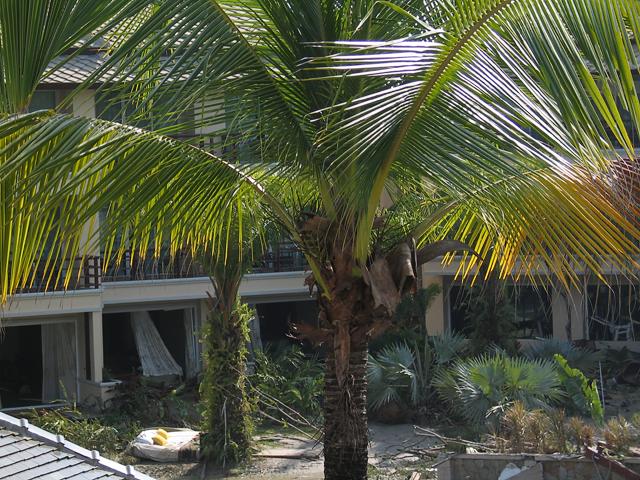 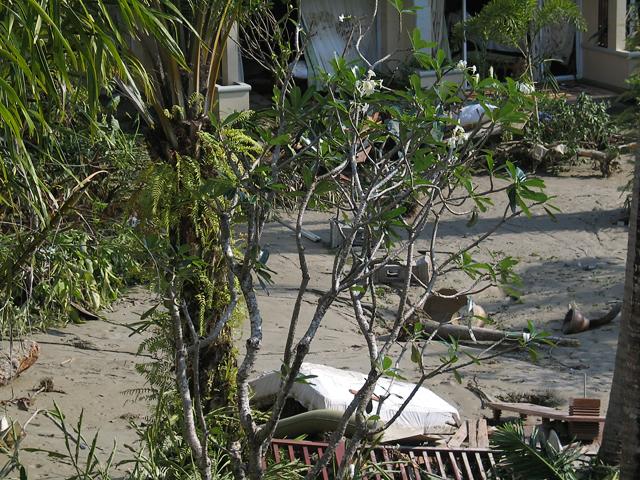 Bedsteads and mattresses float in the thick muddy water. 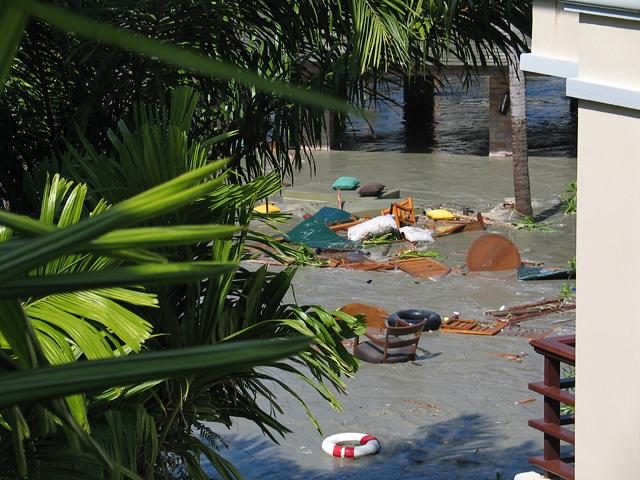 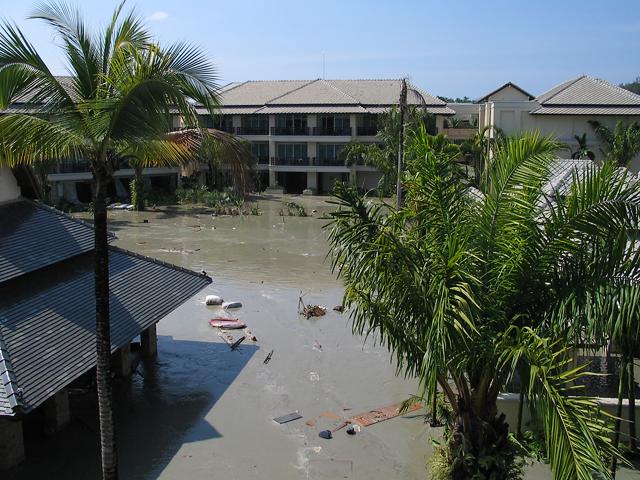 Fear takes hold of me when I look down and see where Don would have been tanning by the pool. A few cushions float over where the pool used to be on their way to the sea. 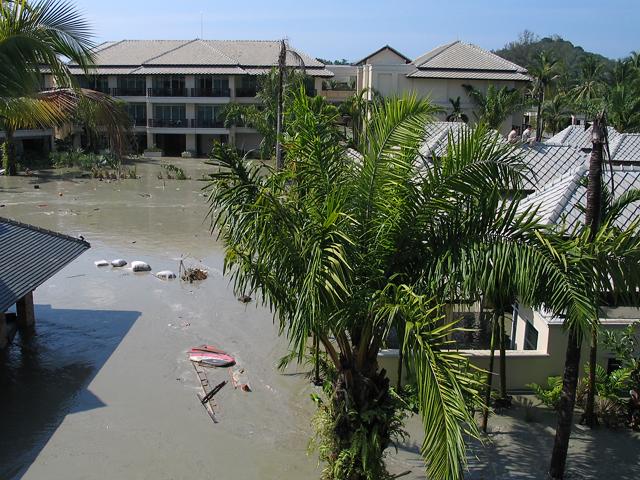 After the water recedes, Don's pool chair lies far from where it was. 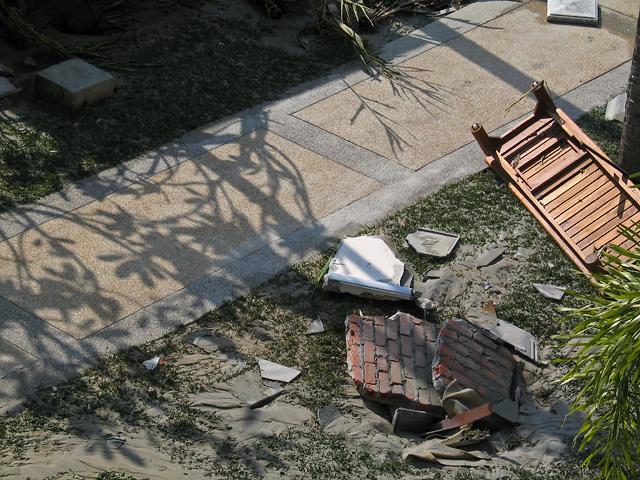 The hotel manager and staff are quick to organize the evacuation of the guests as soon as the water subsides from the driveway of the hotel. 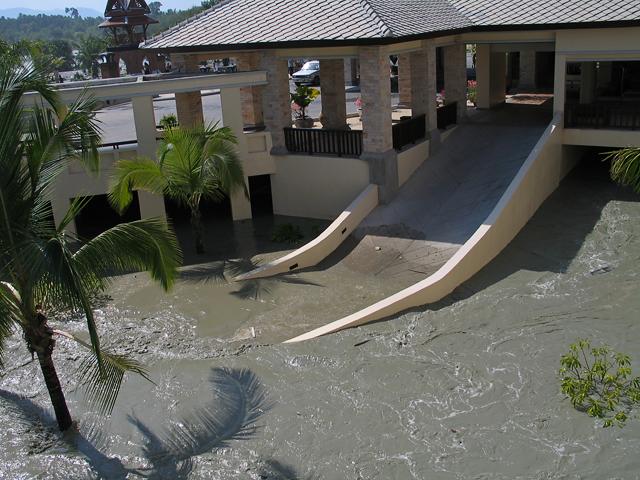 The hotel is not considered secure any more. We are to be evacuated to higher ground and we are to take only essentials like wallets and passports with us, handbags but no luggage. From time to time, staff pass by to announce that we will soon be moving. Don and I decide to take the last transport. A few cars and jeeps take the injured to a hospital an hour away. Jean and Peter leave on the transport to a temple in the mountains. A coach leaves with families. Other transport is found to take some of the guests to a resort further away. Don and I wait until everyone is evacuated and we are the last to leave in a jeep with a woman who is covered in black brine. She had just been dug out of a partially buried room and is in shock. Don gives her a towel to wipe her face but she stares into space, too stunned. We are taken on a very bumpy ride to the Similana Resort next door, the one on the cliffs that we had climbed to after our walk along the beach. There are already many guests here, mostly families, from our hotel. We mill around with confused strangers in the spacious open reception hall with a low wooden wall, which is now crowded. We are about twenty metres above sea level and safe. Refugees that we are, we find our own squatting space in the foyer. We do not get access to any of the wooden chalets of the resort. The tourists speak a variety of continental languages and hardly anyone speaks English, which makes any kind of unity among us a little difficult. Don and I spend our time in dining room overlooking the beach. 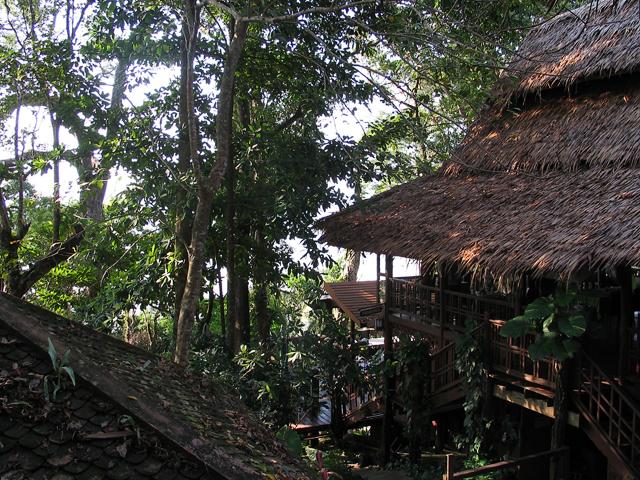 It is deserted except for three people. A couple, bruised and battered, sit looking very tired. Their clothes are torn and they are covered in mud. Later we find out they were on the beach. They had run to their waterfront chalet for shelter when they saw the gigantic wave approach, but the chalet was swamped and it collapsed on them. They were separated. When the wave dragged the chalet out to sea one clung to a pillar and the other to a tree. They eventually found each other and clambered up the almost sheer slope of the cliffs through the shrubs. The third, another European, chain smokes and drinks; he has a cache of beer under the table. He wants to get out of the place and get news to his family. We do not know where the other guests of this hotel have gone. There are signs of guests and staff having left the dining room in a hurry. Many of the tables are partially cleared. 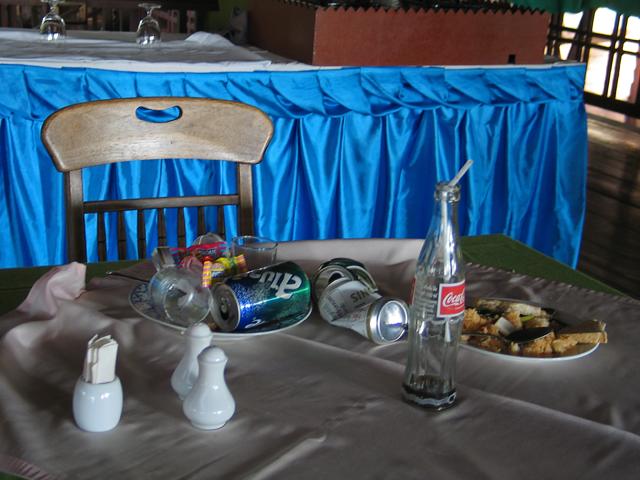 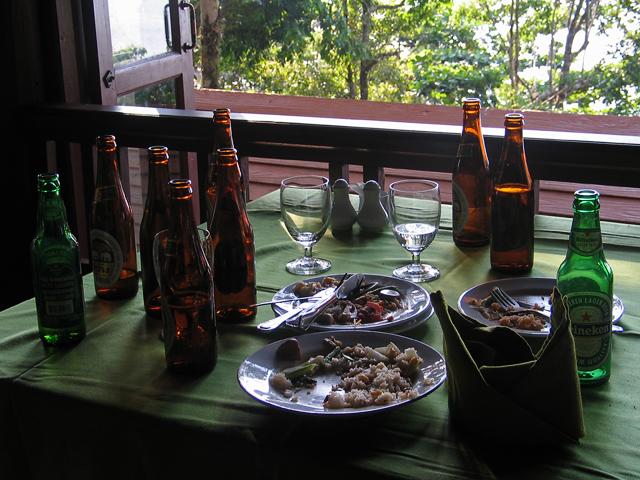 Staff who live near the coastal areas have gone off to check on their families and friends. I find Don skittish. He keeps going back and forth and moving from one picture window to another with his camera, and each time he moves the wooden flooring vibrates and trembles. This annoys me very much; I wish he would settle down but I do not ask him. I feel this detachment from everyone and everything. I feel very much alone, disconnected, and have no desire to talk to anyone or have anything to do with anyone. I read a magazine but cannot concentrate. Don and I watch fascinated as a thin line of white surf in the far horizon comes closer and then disappears. It happens over and over again. 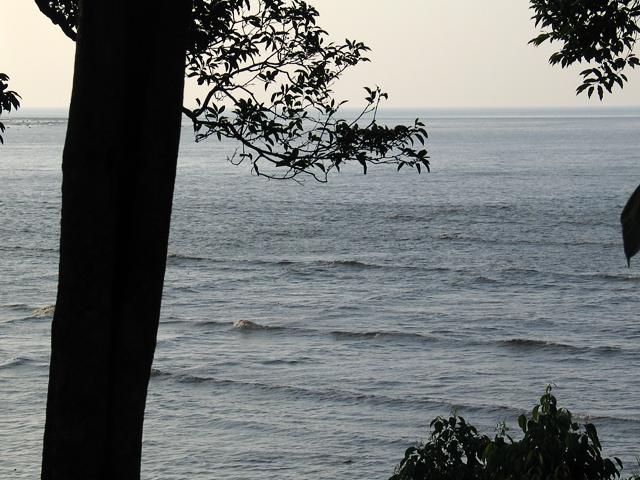 The tides keep coming in and going out, creating a high and low tide every twenty or so minutes. The outward flow leaves vast stretches of mud and exposes underwater rocks. It is not the natural ebb and flow of tide. We see a motor launch come speeding in from the horizon. We are told it is a police launch that has picked up survivors. 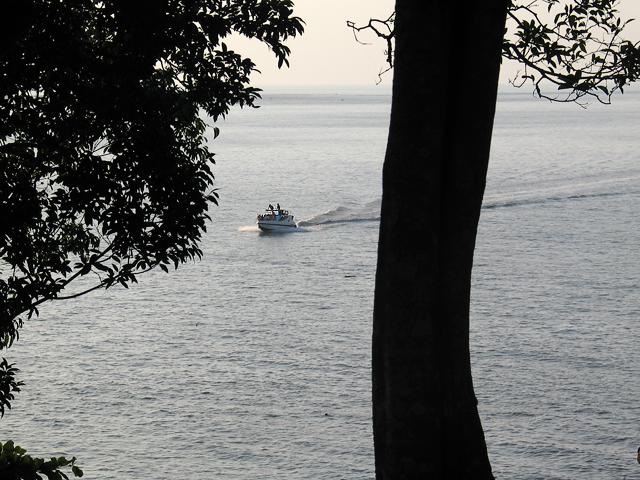 After dropping people on the beach, the pilot heads out but only goes out a few hundred metres when he loses his ability to steer. The water has receded and he is stuck in slush. After several tries, he abandons his boat and trudges the long distance back to shore through the mud. 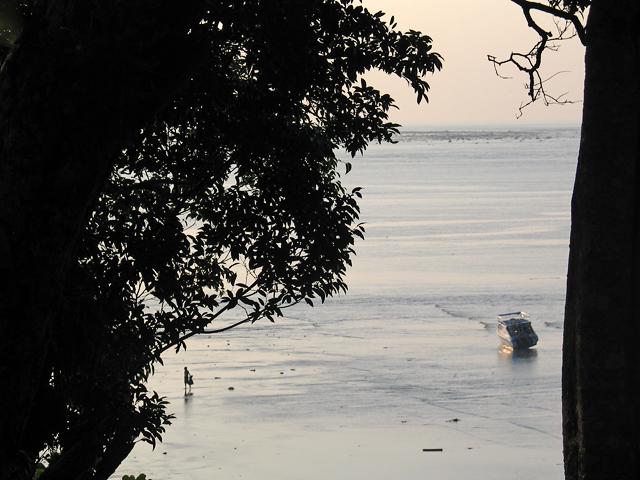 About 3pm we are told that another tsunami is to hit us at 4 pm, a much larger one than the last. This causes a great deal of anxiety. Many parents put inflatable swim bands on their children's arms to at least give them a chance of floating should a second wave hit us above the sea cliff wall. We are asked to move away from the dining room which is too close to the shore, though it’s high up. We go back to the throng of people at the front of the open reception area. There are children crying and mothers, bedraggled and miserable, try to comfort them. Fathers and other male guests, most of them in swimwear, look tired. Some stand in groups, others alone, looking helpless and melancholy. Nobody has had anything to eat since that morning. I go back to the dining room and look around for food and drink but there is nothing available. Eventually I find some sliced white bread that is dry as toast, and some individually packed jam, marmalade and butter. The butter has already turned to oil in the heat. I put them all on a large tray and take it out to the hall where the children and mothers are and leave it on a coffee table. A few people look at me as if I’m an alien, or if not, at least mental. I feel their anger. Perhaps they think I am one of the staff and glare at me for not giving them proper food. Later we are told that the tsunami is not coming. By now no one is sure what to believe. Soon someone comes round and gives us all bottles of water. Don and I share one, and keep the other for later. We are surprised to see the five dogs we met on the beach the evening before, just below the cliff. They are now wandering among the crowd, taking refuge with us and looking for scraps of food. We go back to the quiet of the dining room. A dishevelled woman runs in saying, "I need water. They have found transport for my husband to take him to the hospital. It is a couple of hours away. He is seriously injured. I need water for the trip." I give her our only bottle of water. It is almost sunset and we are bored.  There is no food or water. The bars, restaurants and other outlets are locked. The one toilet that is open is overflowing, with no toilet rolls and no flushing water. Children cry with hunger and discomfort. As evening comes on someone finds bananas and papaya for all of us. There is no milk for the babies, no pills for people with heart conditions or high blood pressure, and no medication for other ailments. Some people are panic-stricken and others walk about dispirited. As darkness approaches we are attacked by hordes of night insects and mosquitoes. Someone comes round with candles. The children are frightened of the dark. Mothers comfort their children as best they can and try to get them to sleep. One of the representatives from our hotel comes over to tell us we can go to our hotel if we choose to, but it may be safer for us to stay where we are until morning. This man is bombarded by inane questions. Those who choose to remain are promised transport at about 9am the next morning. We will be taken to our hotel to collect our cases and then by bus to Bangkok. There is much excited discussion. We pay no attention to what is going on. No transport ever comes, so no one leaves the place. We do not feel the dining room so close to the sea is safe and opt to spend the rest of the night with the other people. There had been a delivery of blankets, quilts and pillows, but not everyone got them, including us. There is hardly any space to spend the night under cover of a roof as everyone has managed to stake out their spots. Don collects some tablecloths off the tables to use as ground sheets and some napkins to protect us from the mosquitoes. We decide to rest on the road. Men and women stand around in small groups talking. Hushed voices tell their horror stories in dozens of different languages. We listen to some weeping families. A short while later a few enterprising men, hotel workers, rig up a two-way radio with a long metal pole as an antenna and get some crackly news of the outside world. There was an earthquake in Indonesia, they say, and another tsunami is on its way and will hit us at 2am. There is more panic and discussions and rushing about. But no tsunami comes that night. Young hotel workers who come from other parts of Thailand, having no homes or families in Khao Lak, begin to relax. The group soon expands to a much larger one with friends from nearby hotels. They gather not far from us, squatting on the ground and chatting quietly. But the party soon gets out of hand. They make themselves comfortable and their talking and laughter gets louder and louder. From time to time one or two of them ride off on a motor scooter and come back with crates of beer or bottles of whisky and gin and vodka. The noise reaches annoying decibels. Added to this is the constant roar of motor vehicles. Though we are outdoors, in the confined area of the resort entrance where we are camped for the night the exhaust fumes build up. This infuriates me. When I can no longer bear the noise and the merry-making, I walk up to them and tell them to stop the noise. I had planed to be calm and kind, but I lose my cool and shout at them. "There are families and children who would like to get some sleep. Many of us have had bad experiences and are sad. Stop this shouting and screaming." They look stunned and whisper to each other, confused. They are probably wondering if I am Thai. They apologise and for the next few minutes they are quiet, but soon the party gets raucous again. It is well into the early morning before many of the boys and girls leave, leaving others stretched out drunk and snoring. We are not sure what the next day will bring, nor do we have any plans. It is a hard cold full moon that looks down on us. There are no sharp stars on this night. All through the night children cry, while men and women weep and talk in whispers. My mantra is: "Please, please, do not let our daughter, my sister and my friends watch television." Without any bedding we try to sleep on a pitch-covered footpath and use the tablecloths: and napkins to keep the mosquitoes at bay. Not far from us, by the side of a small wooden gift shop, are two ladies on sparkling white quilts, made whiter by the bright moon. One of the ladies goes to a van driver and talks to him. She comes back for her friend and they pick up their possessions and leave in the van. Escape from hell for them. We wait a while and then take over their bedding. I feel like a soldier stealing the boots of a dead comrade. We are much more comfortable. The quilt is soft and clean, the feathery pillows are fluffy, the ground does not feel quite so hard. Life is not bad. The night is very cold. We lie awake, each with our own thoughts. We listen to the strange sounds of the birds and insects. Men come one by one and urinate in the bushes close to where we lie. Women come in twos for the same reason, keeping each other company. The mosquitoes attack us all night long, even through the quilts. It is pretty romantic lying close to Don on this full moonlit night. I am quite enjoying this adventure, this camping out. Soon I fall asleep and sleep really well. I remember no occasion when I experienced such deep sleep, with no dreams and no nightmares.  At dawn, Don and I decide not to wait for the promised transport. The morning is bright and with the guardians of the place looking on benevolently we leave.  We trek the four kilometres back to Le Meridien, a walk we have already done before. The main road is devoid of traffic. Later we learn the roads are closed. We see people in hushed groups in doorways of homes. The gate to the resort is not manned by security guards this morning.  There are signs that the tide has reached the gate. The water has subsided and there is mud everywhere. 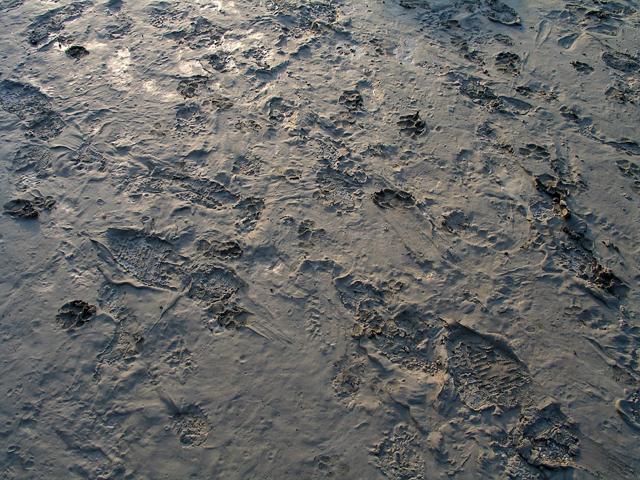 Muddy shoes and slippers line the pathway, signs of people having left in a hurry. 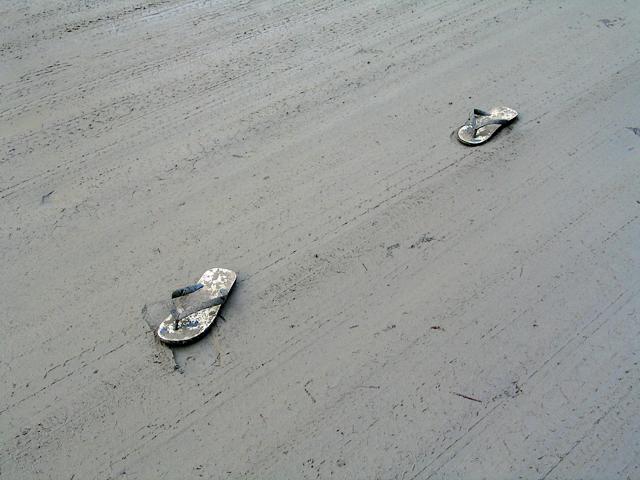 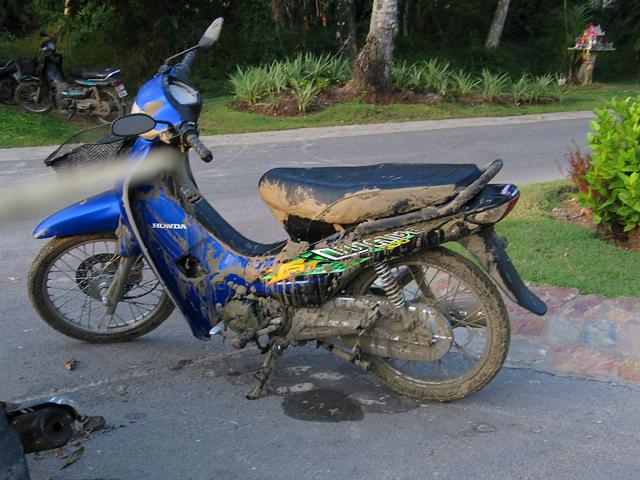 The long walk to our hotel is not easy; the wave has left several centimetres of black mud. A big puzzle is the spirit house partway along the walk that stands intact. There is no sign of mud even on the grass around it. 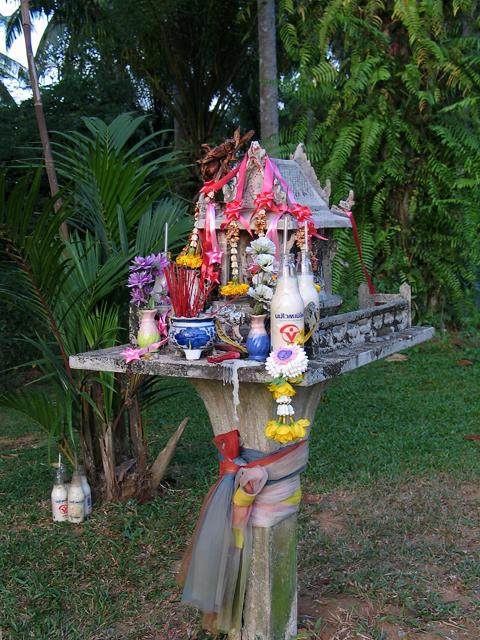 Another larger spirit house close to the resort stands tall and clean, too. 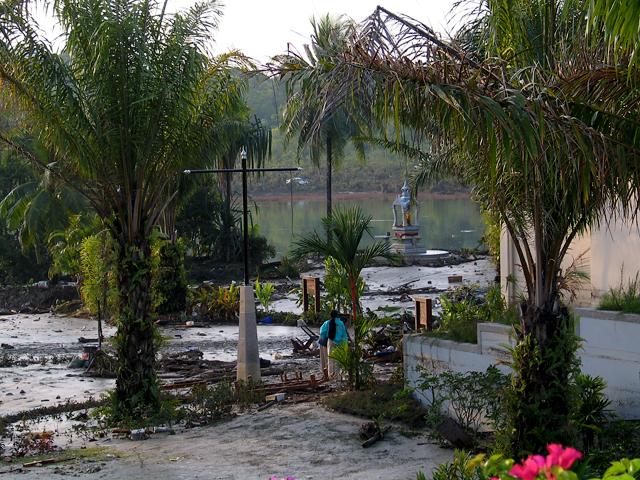 We arrive at our abandoned hotel in our slept-in skimpy clothes, bedraggled, filthy and chewed up by mosquitoes. The sight is heart-wrenching. Everywhere is just mud and destruction. We go past the tennis courts laid waste, their posts and cyclone fencing either washed away or smashed flat. Assorted vehicles are wrecked or piled on top of each other. Motorbikes and scooters are buried in mud. Mud-splattered, sodden suitcases lie about in the debris. 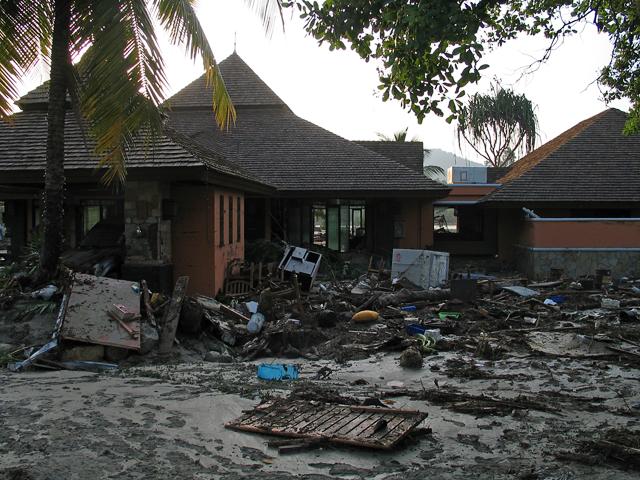 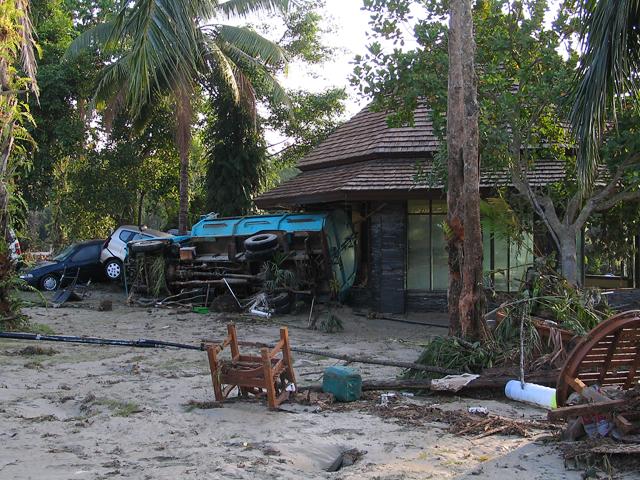 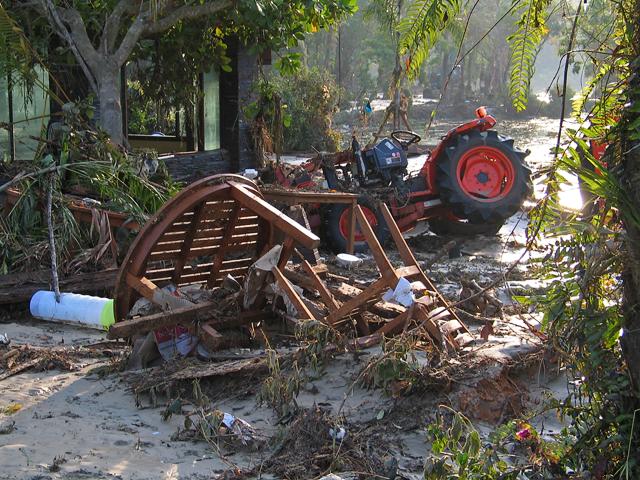 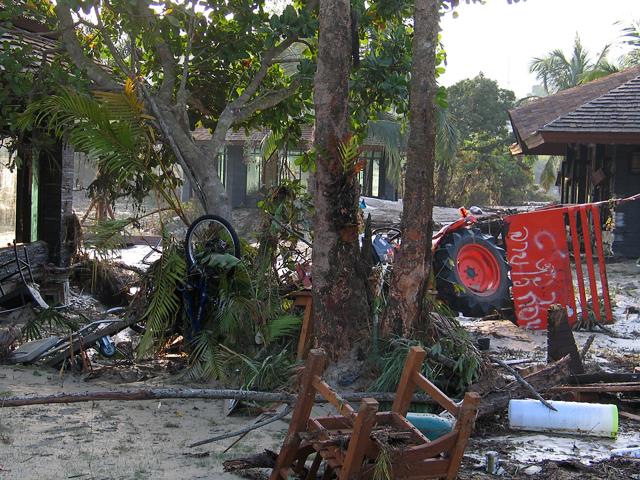 It is difficult to imagine that all this damage was caused by a wave and that there was no wind, no typhoon, no hurricane. One tenacious man tries to kick-start his bike; there is no sputter of life. He shakes off the slushy water and tries again. It does not even cough; the salt water has gone into the working parts. A man in a spotless white uniform stands nearby, watching him. He is too indecently clean in the wreckage around us. I say "Good morning" and we chat. He says he has just arrived from Bangkok to pick up a couple who booked to continue their holiday. He is confused, wonders if the couple will turn up, if they are still alive. It turns out that this is the chauffeur who takes us to Bangkok later. Don and I look around, filled with sadness. The hotel frontage is changed beyond recognition, it is in shambles. The stench of the hotel garbage that is now spread around is overpowering. We walk into a hotel that is deserted, derelict and damaged but still standing calm and safe. An eerie quietness surrounds us. It is heartbreaking to see the destruction of what was such splendour the morning before. No sign of death, but the sensation of something horrible lingers. On our way to the suite, we walk past rooms left in haste. The corridors are still strewn with clothes and shoes, towels and cushions and pillows, places where people took shelter the day before. 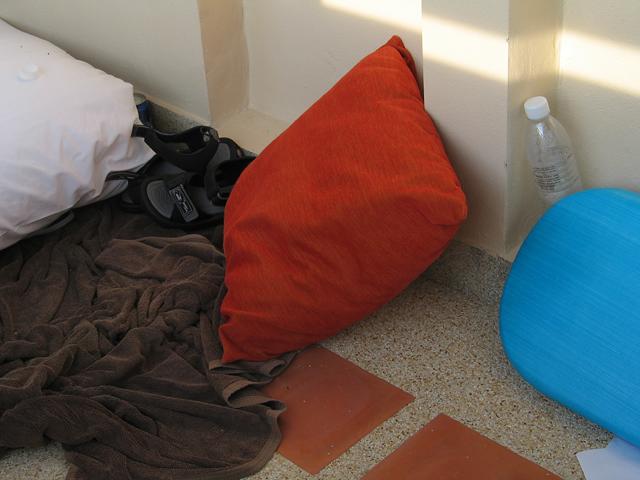 As we walk to our room on the second floor we see large cracks have begun to appear on the walls. Don had the initiative to lock our door from the inside and come out through an adjoining room by climbing over the balcony. He goes back in the same way to get into ours. A man walks past me, the first person I’ve seen other than the two men outside the hotel. To my “Good morning,” he says, "You know you’re not supposed to be here." A rude reply that makes me mad. I think he is arrogant and cold-hearted. It would be better for him to ask if I’m all right. "Yes, I know," I say. “I am waiting to get my things from the room and leave." Later I forgive him. He probably suffered his own tragedy and his statement could have been out of care and concern. It seems that Don is gone for a long while and I begin to worry. But when he opens our door I am proud that he is so resourceful. Our suite is intact, our cases and other belongings untouched. We wash with water from the ice bucket, change clothes, and pack our luggage. As we leave our suite I take a last look from the balcony at the spot where Don tanned every morning, grateful that he had not had time that morning. The place is a shambles. One tall beer bottle stands upright, not Don's. 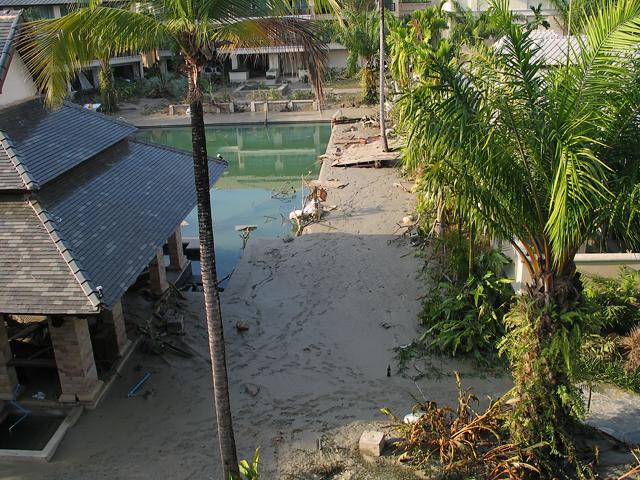 His deck chair has been deposited twenty metres away, leaning against a palm tree. 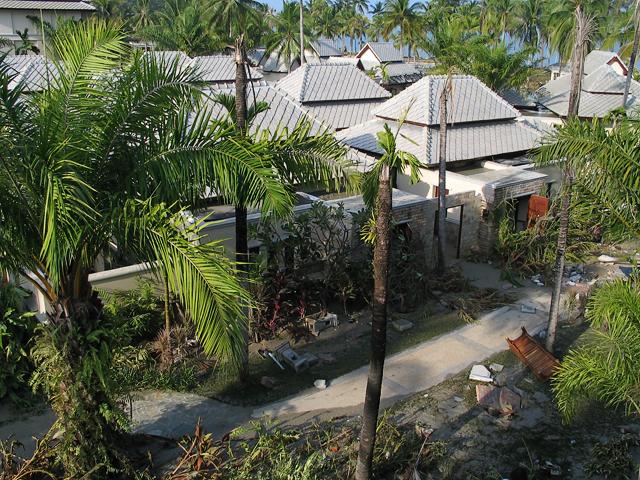 At the foyer we wait for transport to Bangkok; both of us are dejected. We are there for almost an hour when guests that we spent the night with begin to trickle in in batches of five, six and ten in cars and vans. We sit and wait. Workers run about with firemen's axes to break through doors and open safes for the returning guests. We are lucky again. Jean and Peter spot us. The man in the white uniform is happy too -- his charges are alive. They offer us a lift to Bangkok and we gladly accept. The beauty of friendship. We let the hotel know we are leaving and set out on the 11-hour drive to Bangkok. On the way, our driver makes several detours because many of the roads are closed, including part of the main road to Bangkok. We keep trying to telephone our family, friends and neighbours. The telephone system is jammed with callers and we cannot get through. The battery on our cell phone is low. Don checks text messages. We are wildly happy -- our connection with the world is passive but the world has got through to us. The most heart-warming and humorous message is from Shanta: "Mum, I hope that you and Don are okay, that you did not decide to go on a wild shopping spree in Phuket." I could not have asked for anything more precious than that she was ignorant of the fact we were in Khao Lak, the worst-hit place in the region. Relieved by her sense of humour, I laugh but tears roll down my cheeks at the same time. She had only heard about the tidal wave in Phuket and had not seen the news on television because of the Christmas celebrations and partying. It was fortunate I had made the mistake of telling her we were in the mountains. We receive more messages –- from Don's workmates, from friends, from the taxi driver planning to pick us up in Hong Kong, and from an American Express representative. Throughout the day we keep trying to connect with people. Peter is able to connect with their hotel in Bangkok and gets them to send messages to his brother and other members of the family. He and his mother had escaped with only his wallet and their passports. He spends some time laying them open in the sun on the dashboard and turning to new pages as they dry. We stop for lunch at a roadside food court. There is plenty to eat for vegetarians. I am ravenous and end up eating too much. It is only when we get closer to the city that we can use our mobile phone. Though the battery is low, Don sends off some messages that we are safe. We call my sister in Hong Kong several times but get no connection. The rest of the ride is filled with much banter and witty talk, like the only way to cover the tragedy is to joke about it and fill ourselves with silly laughter. It is a morning of innocent optimism; we have no idea of the enormity of the tragedy that hit the regions of the Indian Ocean and the Arabian Sea. The chauffeur says nothing much, but laughs from time to time to keep us company. It is a very long day and we reach Bangkok about eight in the evening. We arrive at The Sukhothai Hotel where Jean and Peter are expected. They have no luggage except for sun-dried passports, a wallet and one small sodden bag, but the staff greet them as if it is normal to have bedraggled customers walk into their posh foyer with no luggage. Don and I are looking comparatively smart and even have our luggage intact. We decide to book into the same hotel. We are told the hotel is fully booked and there is no room available. Eventually the manager, knowing we are friends of Jean and Peter, and that we were almost tsunami victims, finds us a room. I am delighted to be in Bangkok. The city is an added bonus to our holiday, and I promptly announce that we will stay on a few more days and perhaps even do some shopping. We call my sister Sara first and find out she is totally out of her mind with worry. She has hardly slept since she saw the news on television. She spent the night calling embassies and police stations in Thailand to try and get some news of us, which was like checking for a particular grain of sand on those vast beaches. The Chinese embassy in Bangkok told her that they could only help if we were Chinese nationals. She was furious, although I cannot imagine anyone being able to provide information about individuals at this point. She called the local police and Hong Kong Immigration but no one could give her any news. Then we call Shanta and chat with her. She is horrified by she has seen on TV, and delighted that we called as she was not able to contact us. We call our neighbours and let them know we are safe. Until then we had had no news of events outside our own experience. The first thing we do is switch on CNN news and then turn to BBC and then we switch back and forth. We are shocked to see the devastation the tsunami has caused, to watch the casualty figures mount with every passing hour, and to learn of the many coastal regions that were affected. Penang, my home town and the place we thought of going for our holidays, is on the hit list but they have not experienced too big a disaster in spite of being so close to the major tidal wave area. A luxurious hot shower and room-service dinner does nothing to lessen the heartache. My feeling is not so much "Thank God, I am safe" as a feeling of huge loss and huge sorrow for all the pain and suffering of the people left behind on those shores. We stay up late watching the news and the images captured by people with cameras and video cameras. We weep a great deal. We decide to leave as soon as we can get a flight. Sukhothai management and the staff are kind and very helpful. They arrange new air tickets and a limousine to take us to the airport the next morning. 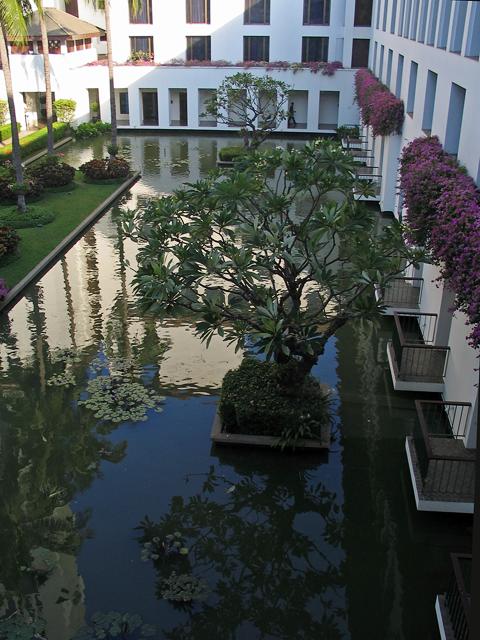  Chaos reigns at the airport. It is overwhelmingly crowded but a man from the hotel helps us with security and prompt check-in and we are soon airborne. We fly out of Bangkok, over pagodas, over the yellow and green roofs of monasteries, over lush forests on undulating ground, over rivers and swamps and then over the sea. As the shadows of clouds move across the blue expanse of the sea below us I cannot look. I cannot connect what has taken place with the calm, blue-green sea below. We fly through white fluffy clouds as we rise higher. We survived the fury caused by the underwater quake, not by endurance but by sheer luck. And now we need the spiritual strength to continue. We feel for those we left behind, not one person known to us, those condemned to survive and to deal with death and loss. The reminder of our mortality does not console us. God took no sides -- Muslims, Buddhists, Christians, Hindus and others perished, but chosen shrines and spirit houses were left standing, Tears keep welling up, I cannot read or talk. Random thoughts and voices, conversations snatched here and there keep going around in my mind, creaking like an old windmill. Questions with no answers keep coming up. Did the beach boys who saved the cushions save themselves from what they thought was a high wave? Only minutes before the wave hit, one of the staff at the buffet table, knowing I am vegetarian, teased me by dangling a piece of bacon over my plate. He was light complexioned and had black mole on his face. Did someone save him from the briny flood? Why were the people laughing or smiling as they ran away from the beach? Were they embarrassed to be running from a mere high wave? The wealthier, more adventurous ones who stayed in the chalets, beach cottages, and hide-away huts -- did they stand a chance of survival? Did those who ran the beachfront sports venues think it was another big wave for surfing? What happened to the couple with a six-month-old baby we saw the night before? They left the baby in the crèche to go swimming early. The crèche was on the ground floor. Who survived there? A 12-year-old boy saved himself by climbing a palm tree and refused to come down when rescuers reached him. His mother said she was pleased she had taught all her children learn to swim at an early age. What did she say to get him down? Did the handsome young Japanese man find his wife? He ran from balcony to balcony, tears streaming down his face, shouting out her name to the flood below. They had been on their honeymoon. A father on the ground floor thrust his baby into the air-vent in the ceiling of their room, bumping her head. He held her there, along with his other young child, as the muddy water reached his shoulders and then receded. All three were saved. But what about the mother? I think of my favourite denim hat. I bought it in Tokyo 15 years ago. On another visit, I scoured Kyoto for silk flowers and had carefully stitched them to the brim. Now a sacrifice to the tsunami, a small one, but it had been a sentimental possession. I also surrendered The Piano Teacher, a paperback that was bookmarked at page 88, a lucky number in Hong Kong. The last paragraph I read was: "A violent spring storm whirled her along. It swept under her flaring skirt, and then crest fallen, let it drop. The air leaden with exhaust fumes, banged and bashed her, clawing her lungs. Objects rattled and crashed against a wall." And the page ends "She braces herself against the storm." In Hong Kong, home bonds are renewed, but the depth of our sorrow is overwhelming. Don and I have us; we hold each other and silently weep. We connect with the pulse we left behind. |

 Don and I were together on this adventure but we took our photos and wrote our stories separately. Different images caught our eye, different words described our thoughts. We didn't read each other's story until we had finished our own. You'll find Don's tsunami diary here. |

